-
Lab1
This is an introductory session to Python and a few libraries that are frequently used in this course (numpy, matplotlib, opencv, keras). -
Lab2
Implementation from scratch of a softmax classifier, trained on CIFAR-10.
Weights visualization

Accuracy: 41.65% on validation set -
Lab3
Convolution implementation and practice with tensorflow on CIFAR-10.- serialization
- use ReLu activations and He initializer
- use regularization
- use dropout
- use cutout (custom layer implementation)
-
Lab4
"The main objective of this laboratory is to familiarize you with the training process of a neural network. More specifically, you'll follow this "recipe" for training neural networks proposed by Andrew Karpathy. You'll go through all the steps of training, data preparation, debugging, hyper-parameter tuning.In the second part of the laboratory, you'll experiment with transfer learning and fine-tuning. Transfer learning is a concept from machine learning which allows you to reuse the knowledge gained while solving a problem (in our case the CNN weights) and applying it to solve a similar problem. This is useful when you are facing a classification problem with a small training dataset."
- custom data generator
- dataset used: GTSRB - German Traffic Sign Recognition Benchmark
- experiment with ResNet blocks
- transfer learning and fine-tuning with MobileNet as base model
- data augmentation
- custom implementation of cosine annealing scheduler
- top 3 ensemble: 98.33% accuracy on validation set
-
Lab5
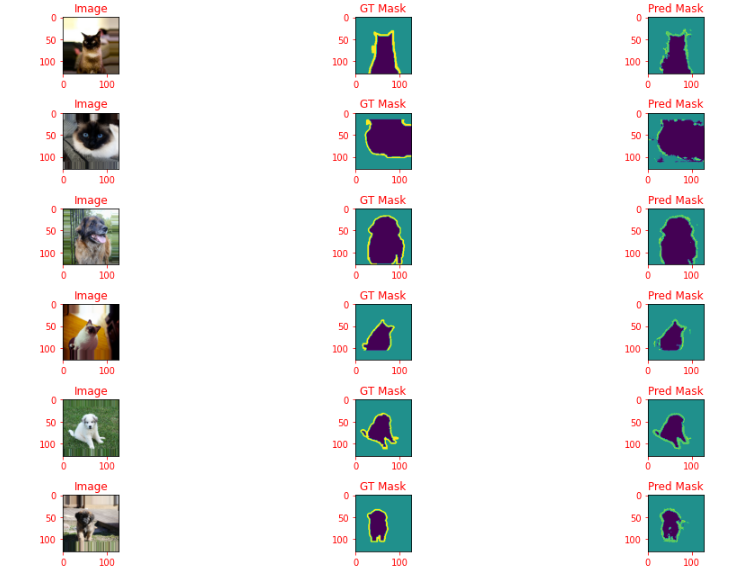
"In this laboratory we'll work with a semantic segmentation model. The task of semantic segmentation implies the labeling/classification of all the pixels in the input image.You'll build and train a fully convolutional neural network inspired by U-Net. Also, you will learn about how you can use various callbacks during the training of your model.
Finally, you'll implement several metrics suitable for evaluating segmentation models."
- image segmentation on OxfordPets dataset
- U-Net downsample and upsample path
- skip connection
- checkpoints, terminate on NaN, early stopping
- mean pixel accuracy: 92.32%
- intersection over union: 70.28%
- frequency weighted intersection over union: 86.83%
-
Lab6
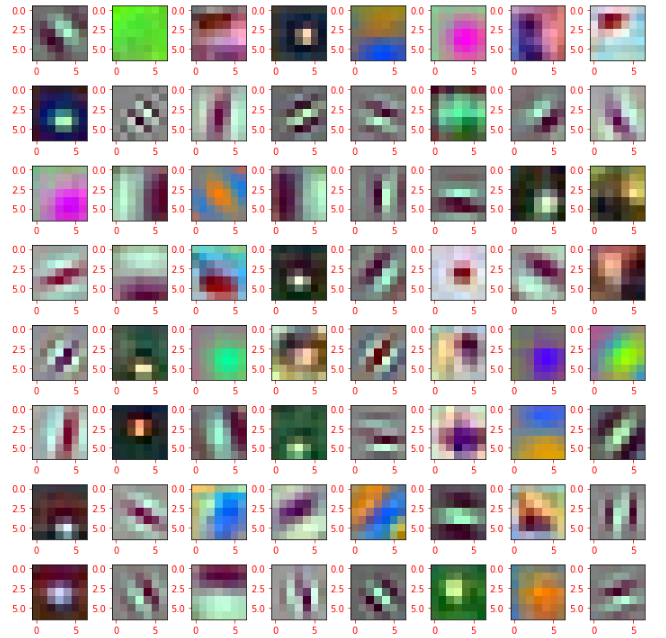
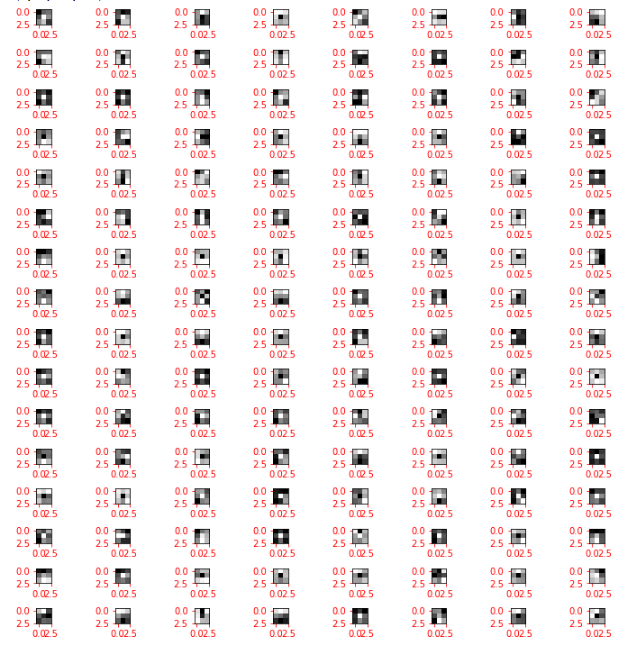
"Visualizing what neural networks learn"
Display the filters in the first and second convolutional layer
Saliency map via image occlusions
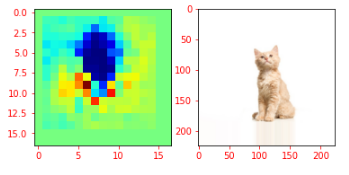
Saliency maps via image derivative
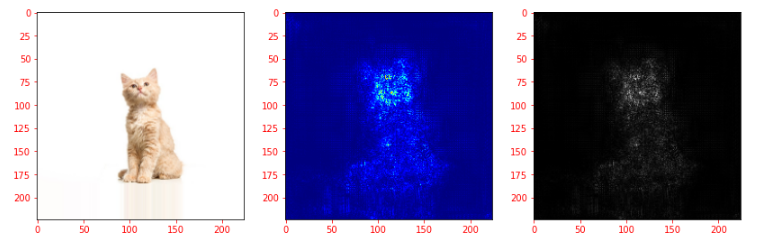
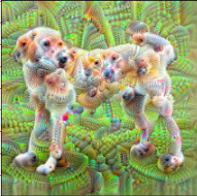
Deep-dream or how to make a network hallucinate
Babeș-Bolyai University
Faculty of Mathematics and Computer Science
Computer Vision and Deep Learning course
Third year