SQL Queries & Concepts
This repository contains the brief about the concepts (its notes) learned and problems solved on LeetCode.
Equi Join: Will retrieve only the data that is equal in both the tables or only retrieves the matching column values; It uses an equality operator to join multiple tables;
SELECT *
FROM TableName11
JOIN TableName2
ON TableName1.ColumnName **=** TableName2.ColumnName;
Non-Equi join: Retrieves data without using the equality operator; Can use other operators except the equality one in the non-equi join to join multiple tables.
SELECT *
FROM TableName1
JOIN TableName2
ON TableName1.ColumnName **[> | < | >= | <= | != | BETWEEN ]** TableName2.ColumnName;**SELECT * FROM `new_schema`.`orders`
WHERE user_id = (
SELECT id FROM `new_schema`.`users`
WHERE name = 'John'
);**- Used for row-by-row processing. Each subquery is executed once for every row of the outer query.
- One way of reading every row in a table and comparing values in each row against related data.
- It is used whenever a subquery must return a different result or set of results for each candidate row considered by the main query. In other words, you can use a correlated subquery to answer a multipart question whose answer depends on the value in each row processed by the parent statement.

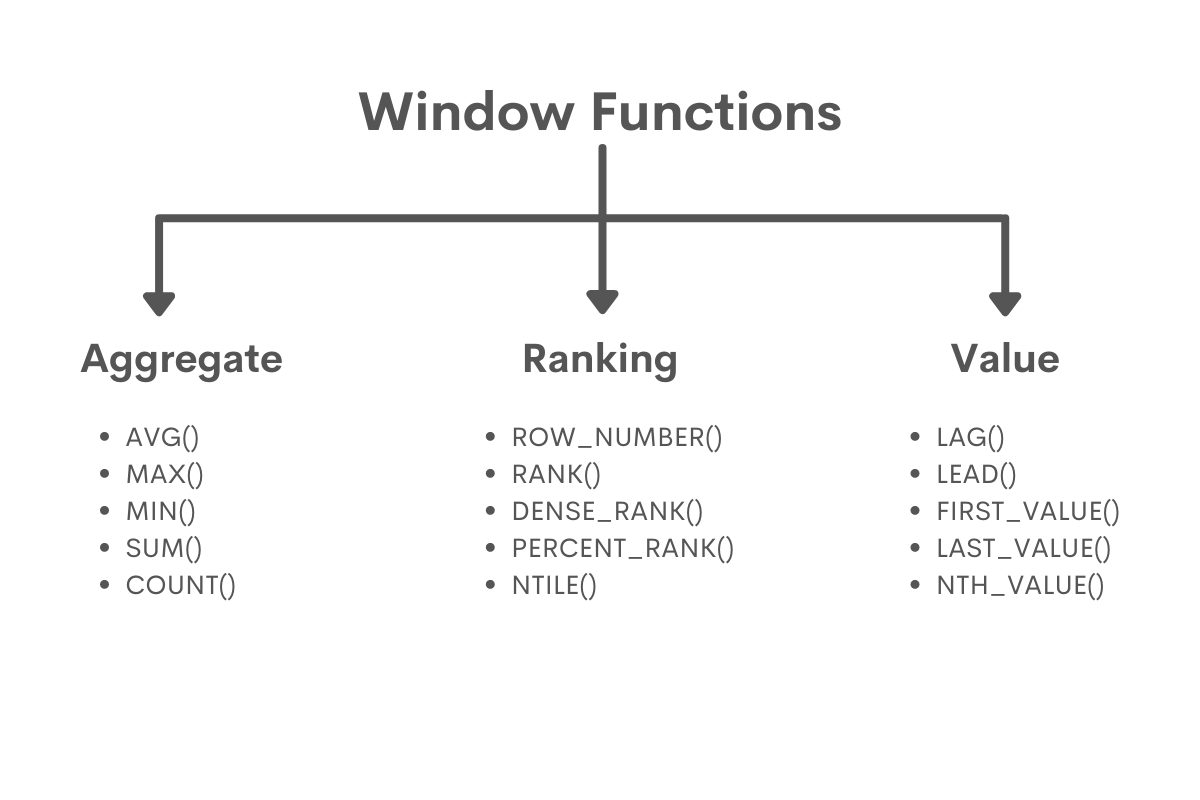
Window Function Categories: (source-Here)
EXAMPLES SOLVED: 001
| Common Table Expression (CTE) | Sub-Queries | |
|---|---|---|
| Complexity | Can be used recursively | Limited nesting levels |
| Reusability | Can be reused in multiple queries | Cannot be reused |
| Performance | Generally faster for complex queries | Can slow down query performance |
| Readability | Can improve readability of complex queries | Can make queries harder to read |
| Availability of columns | Can define additional columns in CTE that are not in underlying tables | Only columns from underlying tables can be accessed |
When to use Sub-Queries:
- Use when a simple query is needed to filter or aggregate data
- Use when data from sub-query is needed in the main query and nested levels are not required
When to use Common Table Expression:
- Use when complex queries need to be broken down into smaller, more manageable parts
- Use when data from sub-query is needed in the main query and nested levels are required.
- The recursion feature can be implemented with
RECURSIVEandUNION ALL
WITH RECURSIVE [cte_name] (column, ...) AS (
  [non-recursive_term]
UNION ALL
  [recursive_term])
SELECT ... FROM [cte_name];

# Fibonacci Example
WITH RECURSIVE fib(f1, f2) AS (
    SELECT 0, 1
    UNION ALL
    SELECT f2, (f1+f2) FROM fib )
SELECT f1 FROM fib LIMIT 10;