
Trust scoring for GitHub PR authors based on contribution history.
AI has made mass pull requests trivial to generate, eroding the signal that a PR represents genuine investment. Good Egg is a data-driven answer: it mines a contributor's existing track record across the GitHub ecosystem instead of requiring manual vouching. See Methodology for the full approach or read the blog post for a higher-level overview.
Try Good Egg without installing anything (requires uv):
# Requires a GitHub personal access token
GITHUB_TOKEN=<token> uvx good-egg score <username> --repo <owner/repo>
This runs Good Egg in a temporary environment with no install needed.
pip install good-egg          # Core package
pip install good-egg[mcp] # With MCP server supportAdd Good Egg to any pull request workflow:
name: Good Egg
on:
  pull_request:
    types: [opened, reopened, synchronize]
permissions:
  pull-requests: write
jobs:
  score:
    runs-on: ubuntu-latest
    steps:
      - uses: 2ndSetAI/good-egg@v0
        with:
          github-token: ${{ secrets.GITHUB_TOKEN }}
Add checks: write to permissions if you enable check-run: true.
Example PR comment
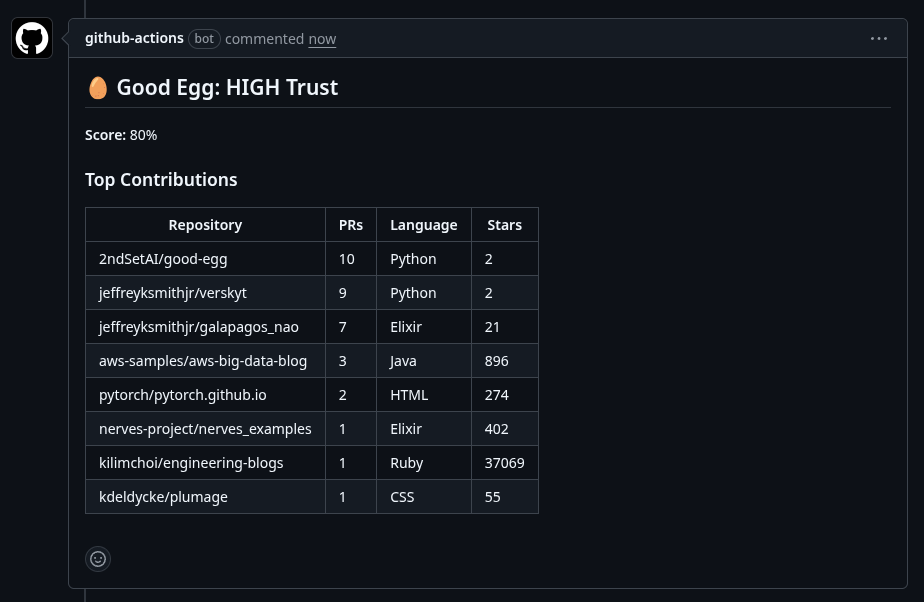
See docs/github-action.md for inputs, outputs, and advanced configuration.
good-egg score <username> --repo <owner/repo>
good-egg score octocat --repo octocat/Hello-World --json
good-egg score octocat --repo octocat/Hello-World --verbose
good-egg cache-stats
good-egg cache-clear
good-egg --version
good-egg --helpimport asyncio
import os
from good_egg import score_pr_author
async def main() -> None:
result = await score_pr_author(
login="octocat",
repo_owner="octocat",
repo_name="Hello-World",
token=os.environ["GITHUB_TOKEN"],
)
print(f"{result.trust_level}: {result.normalized_score:.2f}")
asyncio.run(main())See docs/library.md for full API documentation.
pip install good-egg[mcp]
GITHUB_TOKEN=ghp_... good-egg-mcp
Add to Claude Desktop (claude_desktop_config.json):
{
  "mcpServers": {
    "good-egg": {
      "command": "good-egg-mcp",
      "env": { "GITHUB_TOKEN": "ghp_your_token_here" }
    }
  }
}
See docs/mcp-server.md for tool reference.
Good Egg supports three scoring models:
| Model | Name | Description |
|---|---|---|
v3 |
Diet Egg (default) | Alltime merge rate as sole signal |
v2 |
Better Egg | Graph score + merge rate + account age via logistic regression |
v1 |
Good Egg | Graph-based scoring from contribution history |
v3 is the default. To use an older model, set scoring_model: v1 or
scoring_model: v2 in your .good-egg.yml, pass --scoring-model v1 on
the CLI, or set scoring-model: v1 in the action input. See
Methodology for how each model works.
Accounts less than 365 days old receive a "Fresh Egg" advisory in the output. This is informational only and does not affect the score. Fresh accounts correlate with lower merge rates in the validation data.
The default v3 model (Diet Egg) scores contributors by their alltime merge rate: merged PRs divided by total PRs (merged + closed). Older models (v1, v2) build a weighted contribution graph and run personalized graph scoring. See Methodology for details.
| Level | Description |
|---|---|
| HIGH | Established contributor with a strong cross-project track record |
| MEDIUM | Some contribution history, but limited breadth or recency |
| LOW | Little to no prior contribution history -- review manually |
| UNKNOWN | Insufficient data to produce a meaningful score |
| BOT | Detected bot account (e.g. dependabot, renovate) |
| EXISTING_CONTRIBUTOR | Author already has merged PRs in this repo -- scoring skipped |
thresholds:
  high_trust: 0.7
  medium_trust: 0.3
graph_scoring:
  alpha: 0.85
Environment variables with the GOOD_EGG_ prefix can override individual
settings. See docs/configuration.md for the full
reference and examples/.good-egg.yml for a
complete example.
See docs/troubleshooting.md for rate limits, required permissions, and common errors.
MIT
Egg image CC BY 2.0 (Flickr: renwest)