feat(pipeline): multi-model plan → code → review pipeline task type#629
Conversation


Borrowed from herdr's herdr-plan-code-review: one goal is split into an
ordered chain of phase tasks, each routed to its own executor and model,
that hand work forward on one shared git branch and advance automatically.

The default `plan-code-review` pipeline runs three phases on one branch:
Plan (Claude/Opus, writes PLAN.md) → Code (Claude/Sonnet, implements) →
Review (Codex, reviews with fresh eyes and opens the PR).

Assembled entirely from existing primitives — no bespoke execution engine:
- per-task Executor + Model overrides give each phase a different agent;
- task dependencies with auto_queue chain the phases (completing one
  auto-queues the next via db.ProcessCompletedBlocker);
- a pinned BranchName on phase 1 + SourceBranch on the rest keeps every
  phase on one branch so each sees the previous phase's commits.

The normal daemon executor runs each phase task in turn.

New:
- internal/pipeline: Phase/Definition model, built-in plan-code-review
  definition, and Create() that builds the dependency chain.
- `ty pipeline <goal>` CLI command (+ --list, --definition, --no-execute,
  --permission-mode, --json).
- taskyou_create_pipeline MCP tool.
- setupWorktree now honors a caller-pinned BranchName so a pipeline can
  route several phases onto one shared branch.

Tests: pipeline build/chain/auto-queue/validation, branch-name honoring.

Co-Authored-By: Claude Opus 4.8 (1M context) <noreply@anthropic.com>
Add the pipeline entry point to the TUI (TaskYou is TUI-first) and make the
default pipeline degrade gracefully when an executor isn't installed.

TUI:
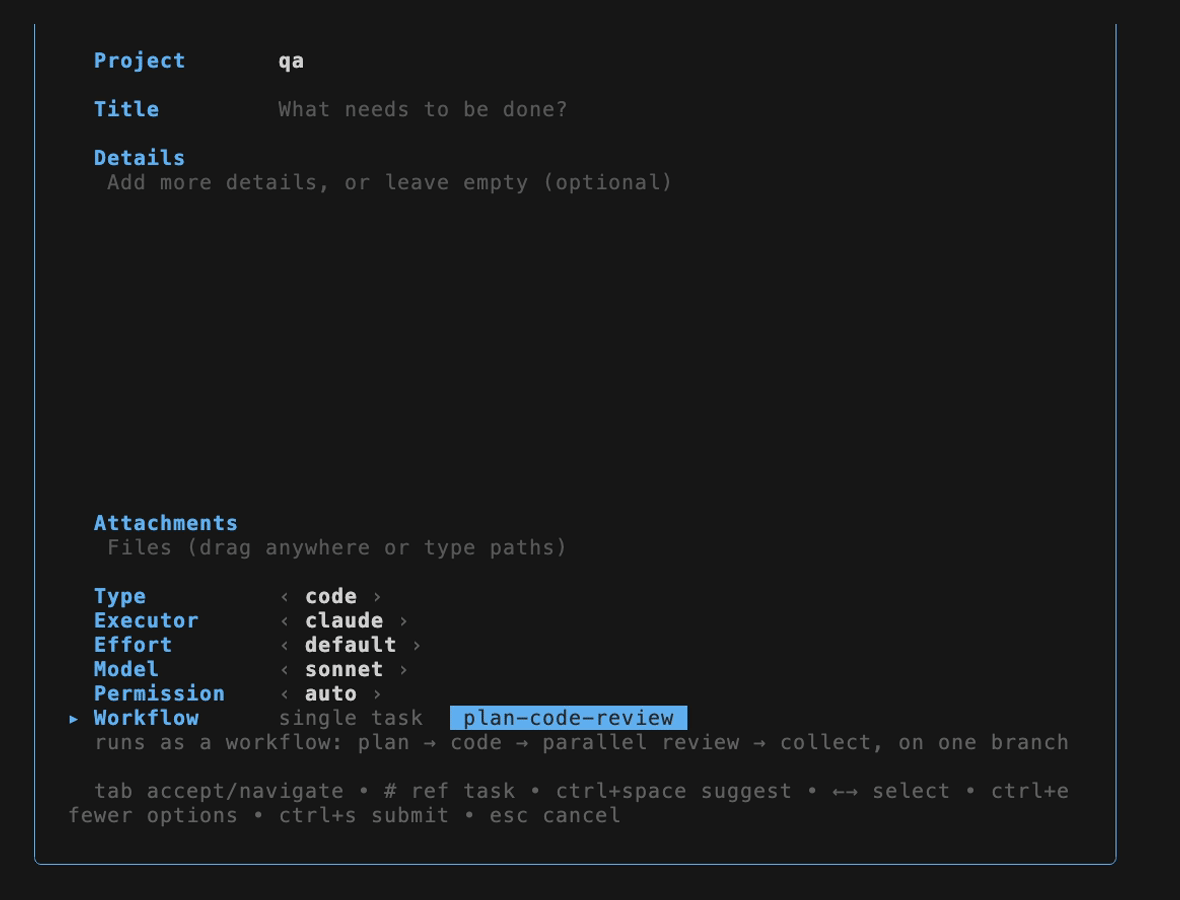
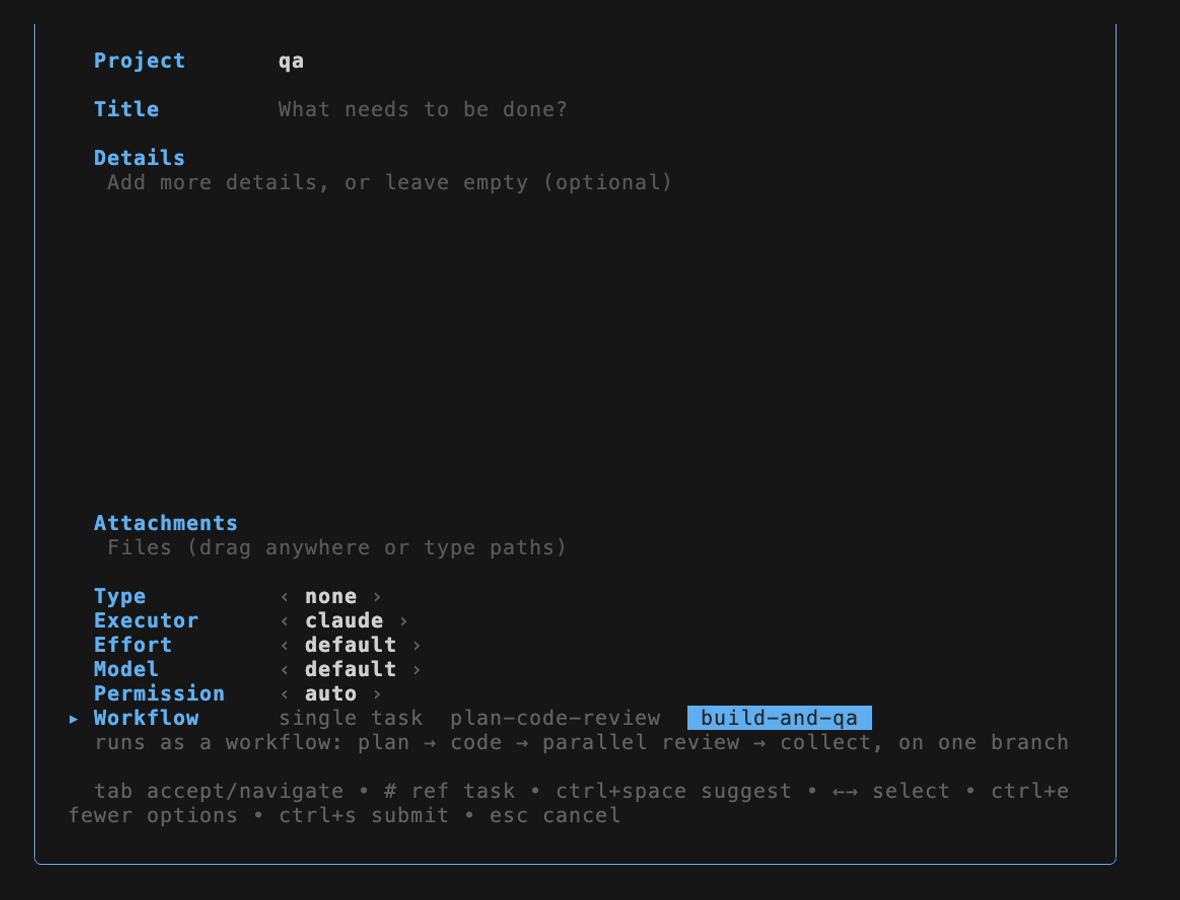
- New "Pipeline" selector in the new-task form (advanced fields), mirroring
  the existing Executor/Permission selectors: "single task" (default) or a
  pipeline definition. Selecting one turns submit into pipeline.Create using
  the form's title/body as the goal and its project/permission for every phase.
- The queue confirm reads "Start the pipeline now? / stage all phases" for a
  pipeline, and a toast reports the created chain + branch.
- Hidden when editing an existing task.

Executor fallback:
- pipeline.Create takes an optional AvailableExecutors set; any phase whose
  executor isn't installed falls back to Claude (recorded in Result.Fallbacks
  and surfaced in the CLI/TUI). So a missing Codex no longer strands the Review
  phase — the pipeline still runs end-to-end. CLI and TUI pass the host's
  available executors; an empty set disables the check.

Tests: form pipeline field (default, cycle, visibility, render); pipeline
fallback + no-fallback. QA'd via the ty-qa VHS harness (board, form selector,
selected state, confirm, end-to-end TUI creation).

Co-Authored-By: Claude Opus 4.8 (1M context) <noreply@anthropic.com>

Follow-up round 2: configurable phases, no Codex default, TUI + QAAddressing the review feedback ( No more Codex default / fallbackThe default pipeline is now all Claude — Configurable per project, persisted (set once → always your choices)Each phase's executor+model is configurable per project and saved (settings key New Partial edits merge onto current config; unknown phase names / executors error clearly. TUI affordance (from the prior round)New-task form gained a Pipeline selector (advanced fields); selecting a definition turns submit into a pipeline build, with a pipeline-aware confirm and a board toast. QA'd via the
(The board card labels show All package tests + Follow-up: a TUI screen to edit |
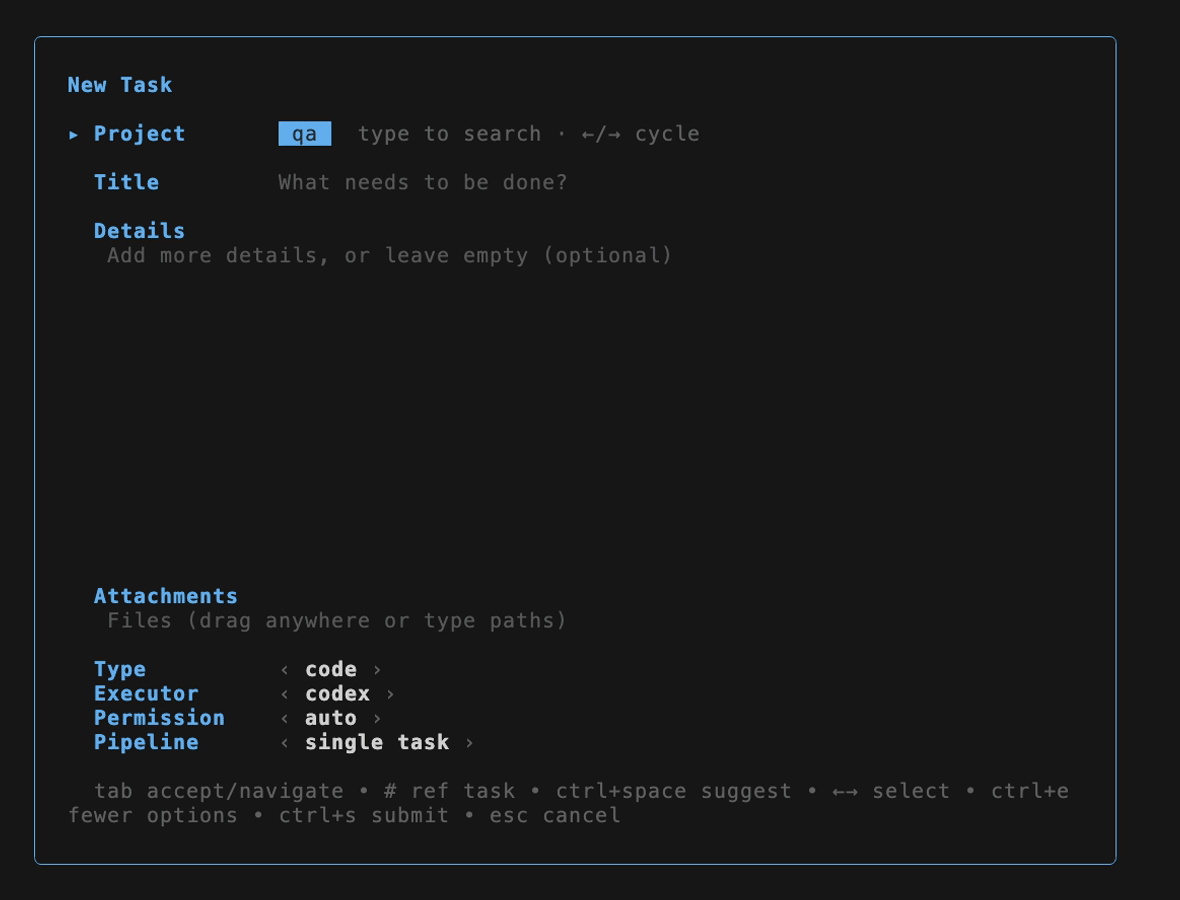
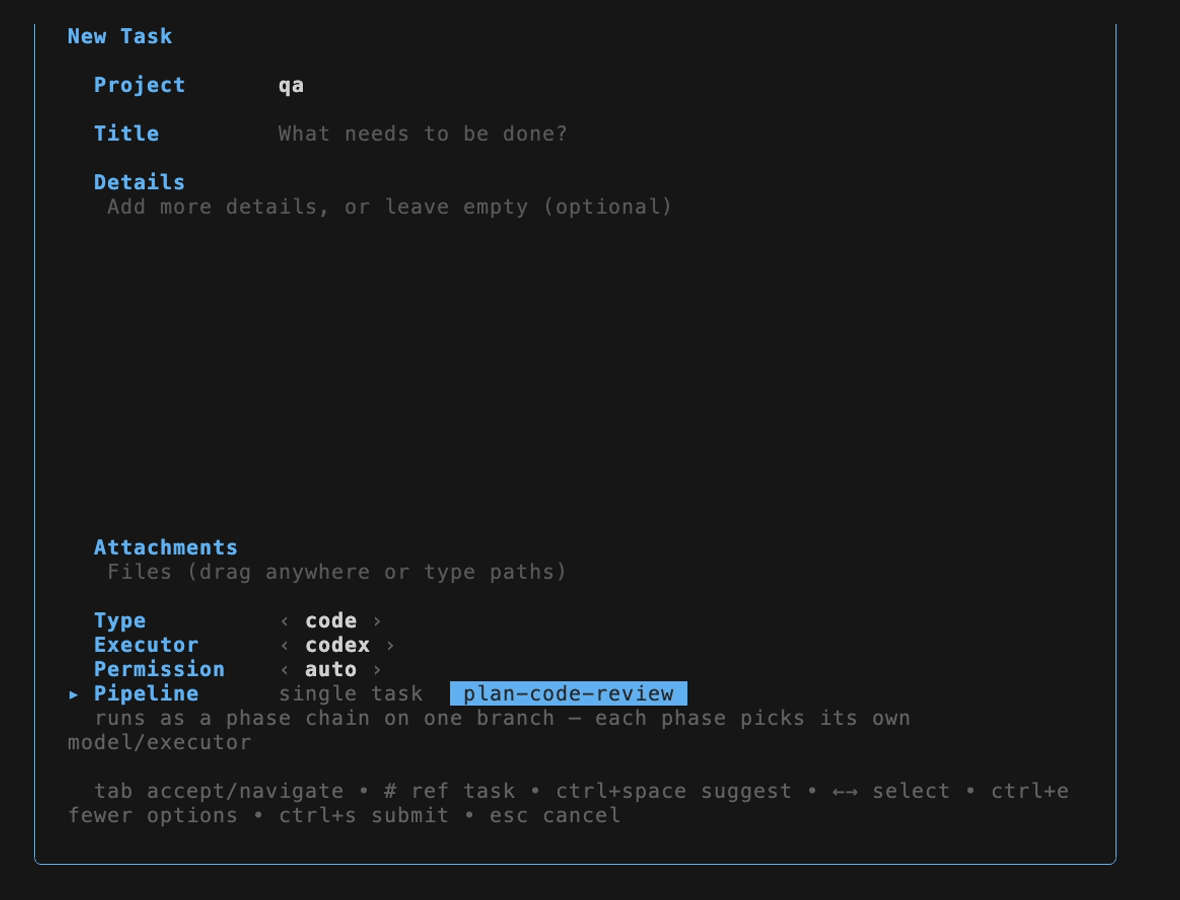
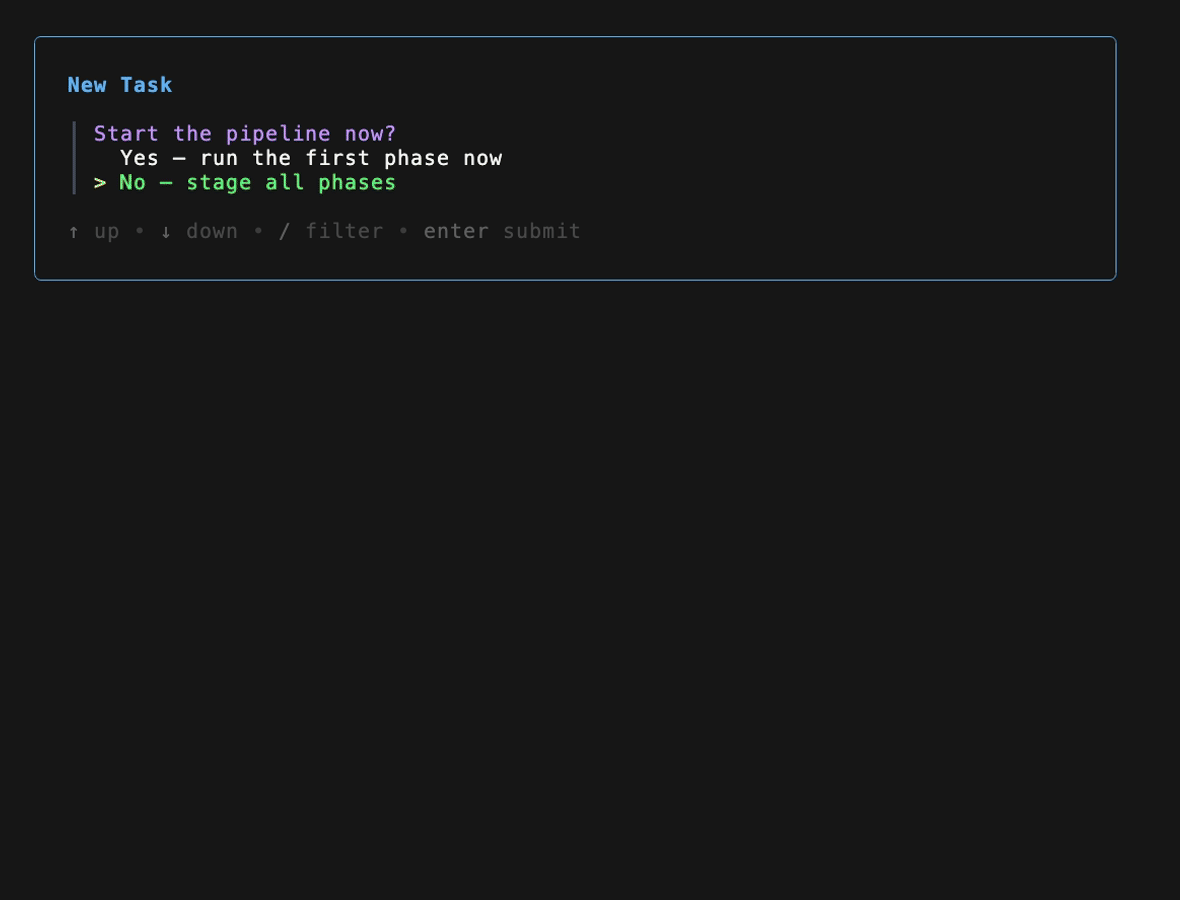
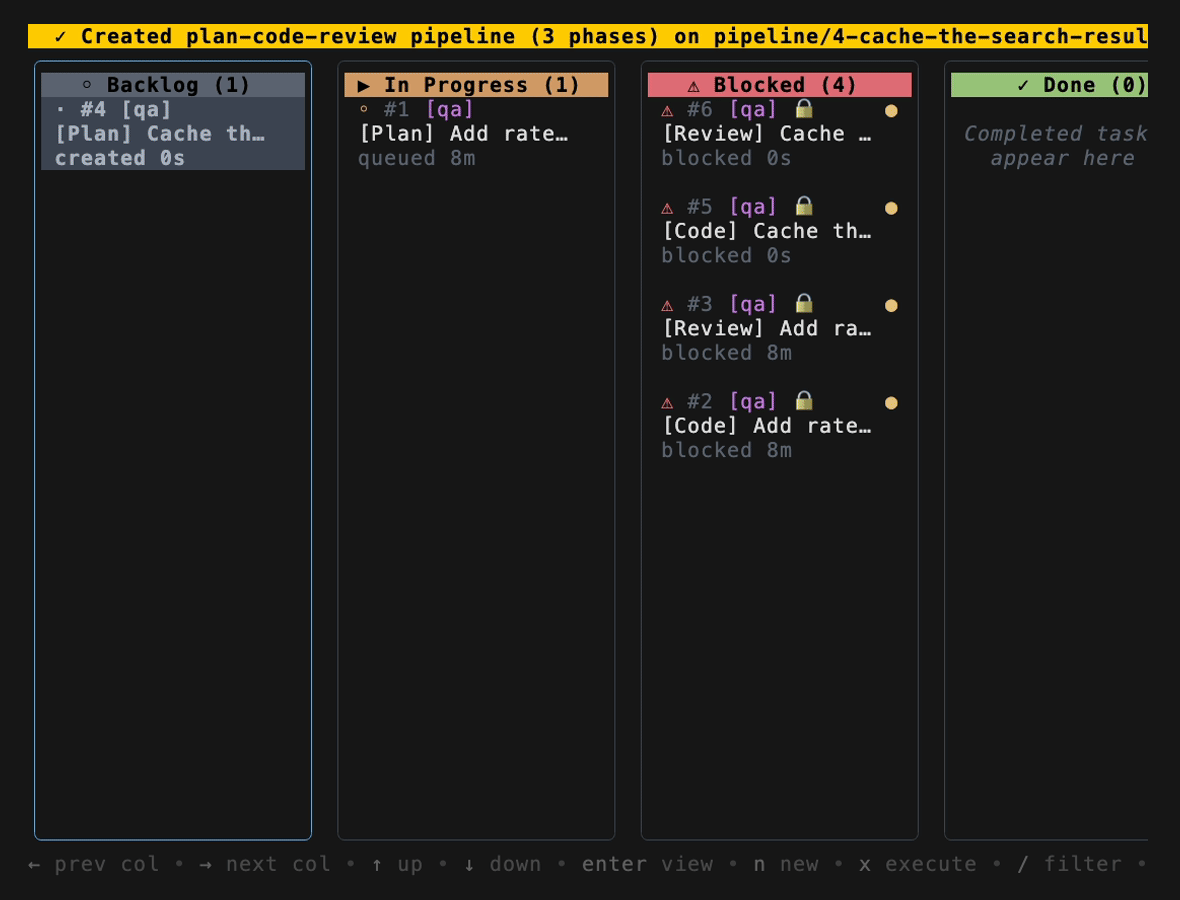
…default

Address review feedback: the default pipeline no longer hardwires Codex with a
Claude fallback. Instead:

- Defaults are all-Claude (Plan=opus, Code=sonnet, Review=opus) — works on any
  host, never silently swaps executors.
- Each phase's executor+model is configurable per project and persisted, so you
  set it once ("Review runs on codex for this repo") and every pipeline there
  defaults to your choices. Stored in settings under pipeline_config:<proj>:<def>.
- New `ty pipeline config` command: view / --set "Phase=executor[/model]" /
  --reset. pipeline.Create applies the saved config via EffectivePhases; the
  TUI and MCP paths pick it up automatically.
- Removed the AvailableExecutors fallback machinery (no longer needed now that
  the default is always-available Claude and executor choice is explicit config).

Tests: config round-trip (save/merge/clear), Create honors saved config, chain
defaults updated to all-Claude. Verified the config CLI end-to-end.

Co-Authored-By: Claude Opus 4.8 (1M context) <noreply@anthropic.com>
 bborn
force-pushed
the
task/4640-herdr-borrow-plancodereview-multi-agent
branch
from
bborn
force-pushed
the
task/4640-herdr-borrow-plancodereview-multi-agent
branch
from
d824354 to
ed350ef
Compare
… card)

Reworks the linear pipeline into a proper workflow DAG, addressing review
feedback that a straight chain couldn't express the parallel dual-review that
is the herdr flow's whole point, and that N linked tasks cluttered the board.

Model (internal/pipeline):
- Steps form a DAG: each Step has Deps; sequential where steps depend on each
  other, parallel where they don't. Default plan-code-review is now
  Plan → Code → [Review A ∥ Review B] → Collect, built on the existing task
  dependency graph (fan-out + join via auto_queue; validated for single-root,
  acyclic, unique names). Collect opens the PR — the one human gate.
- Parallel reviewers push to their OWN branch (single push, no rebase), and
  Collect reads each via an injected {{reviews}} list. This replaces a
  shared-branch rebase-push that real-agent QA proved a weak model botches by
  clobbering the other reviewer's file.
- Per-project step executor/model config carried over (StepConfig).

Board (internal/ui):
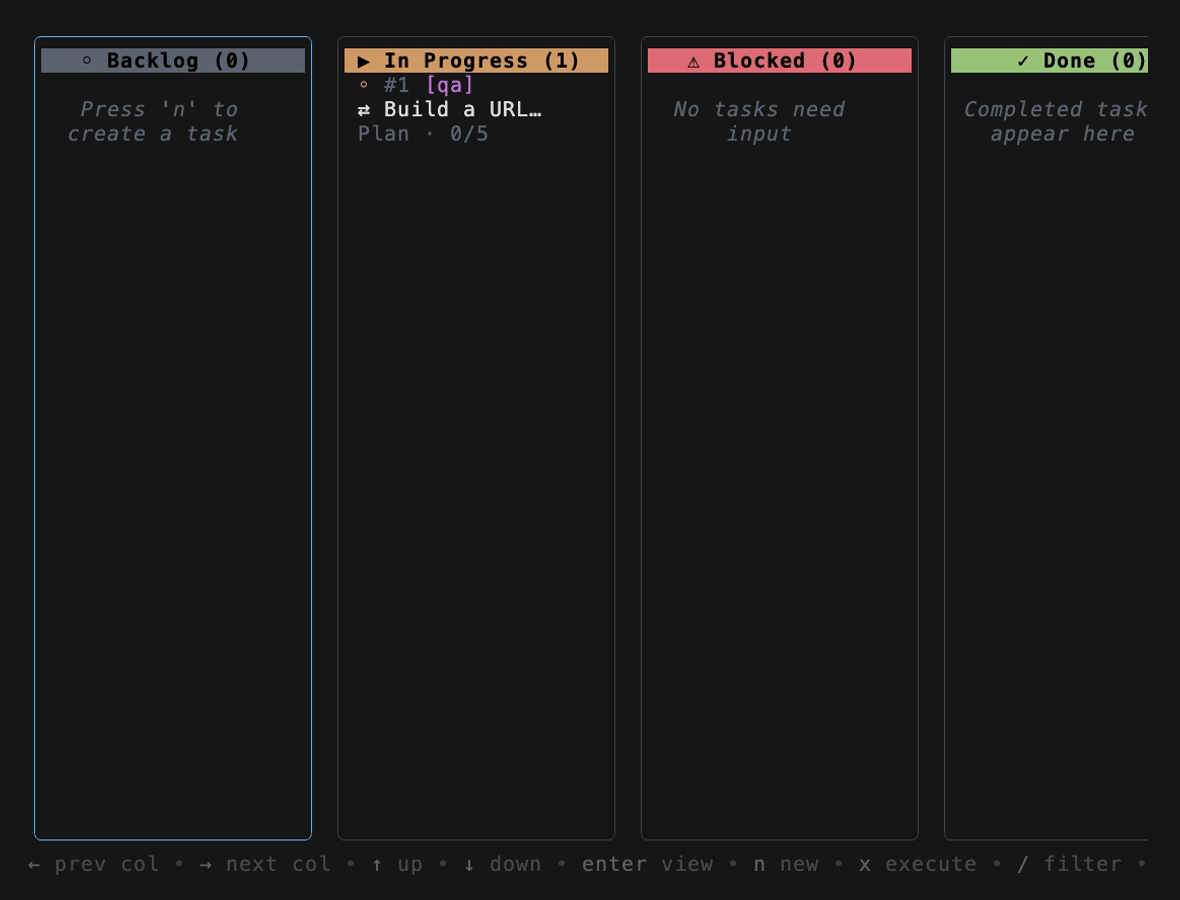
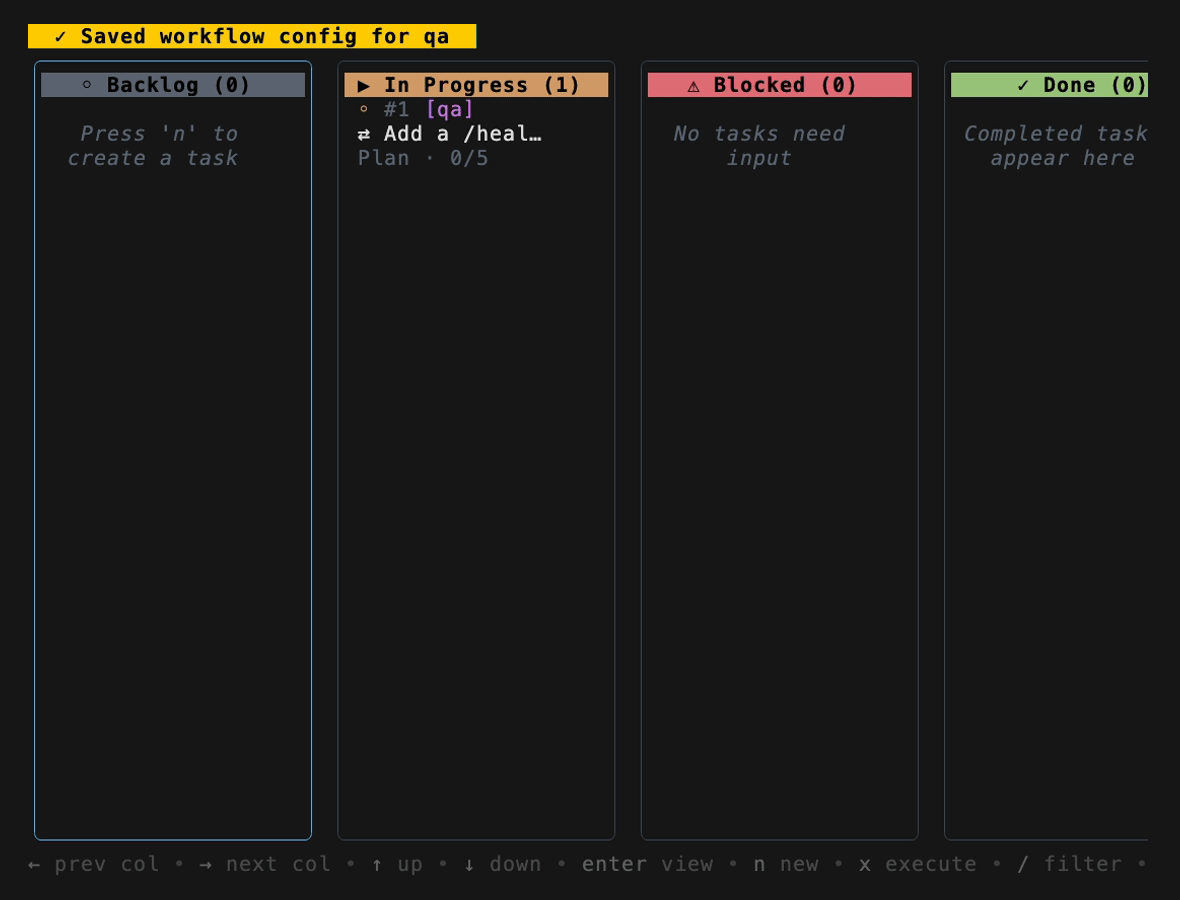
- A workflow's step tasks collapse into ONE lead card showing the goal and
  current step + progress ("⇄ goal" / "Review ∥ · 3/5") instead of N cards.
  Done via a pre-pass (pipeline.GroupWorkflows) feeding the board; the Kanban
  render cache signature includes the workflow badge.
- Form selector renamed Workflow; the confirm drops the confusing "stage all
  phases" wording for plain start-now / save-for-later.

CLI/MCP updated for steps + DAG; `ty pipeline config` edits per-step models.

Tests: DAG build/validation, parallel fan-out + join auto-advance, per-branch
review handoff, config round-trip, workflow grouping/lead/progress.

QA: ran the real flow end-to-end with live Claude agents (plan → code → two
parallel reviewers → collect) on a git repo with a remote — which is how the
reviewer-clobber bug was found and fixed.

Co-Authored-By: Claude Opus 4.8 (1M context) <noreply@anthropic.com>
Round 3: rebuilt as a workflow DAG — parallel review, one board card, real-agent QAWent back to how herdr actually works (Plan → Code → two parallel reviewers → collect) and reworked the linear pipeline into a real workflow DAG. Commit What changed
Board: one collapsed card (was 5)QA — actually ran it end-to-end with live agentsRan the real rendered step prompts through live Claude agents on a git repo with a remote — Plan (sonnet) → Code (sonnet) → Review A (haiku) ∥ Review B (sonnet), concurrently → Collect (sonnet), goal: "add fizzbuzz.py + a pytest test". This caught a real bug. With the reviewers pushing to a shared branch, the weaker model botched the rebase-push and clobbered the other reviewer's file. Fixed: each reviewer now pushes to its own branch (single push, no rebase, no race), and Collect reads each explicitly. Re-ran — both reviews survive: Collect read both reviews, applied Review B's All package tests + Follow-ups
|
Configuring a workflow's per-step executor/model was CLI-only; add a TUI
editor so it's doable in the board (TaskYou is TUI-first).

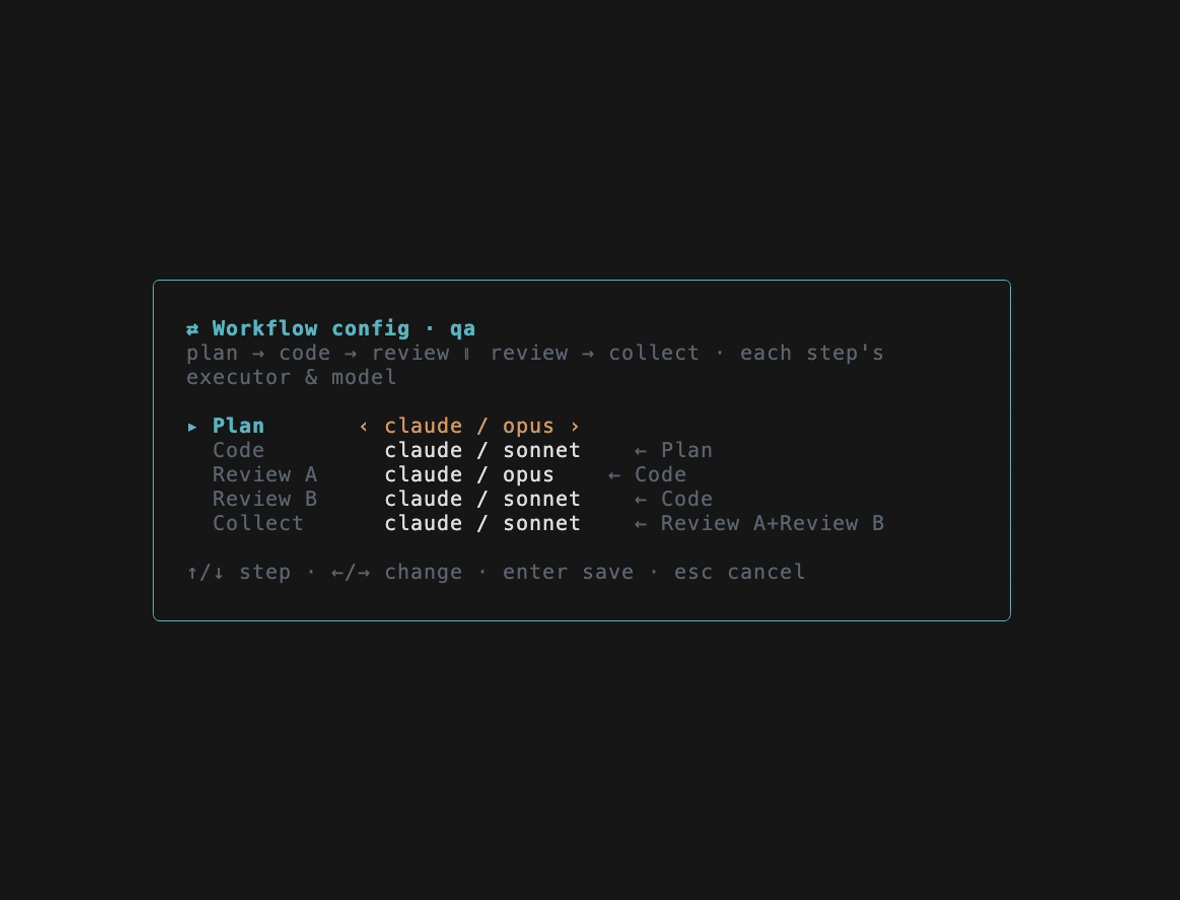
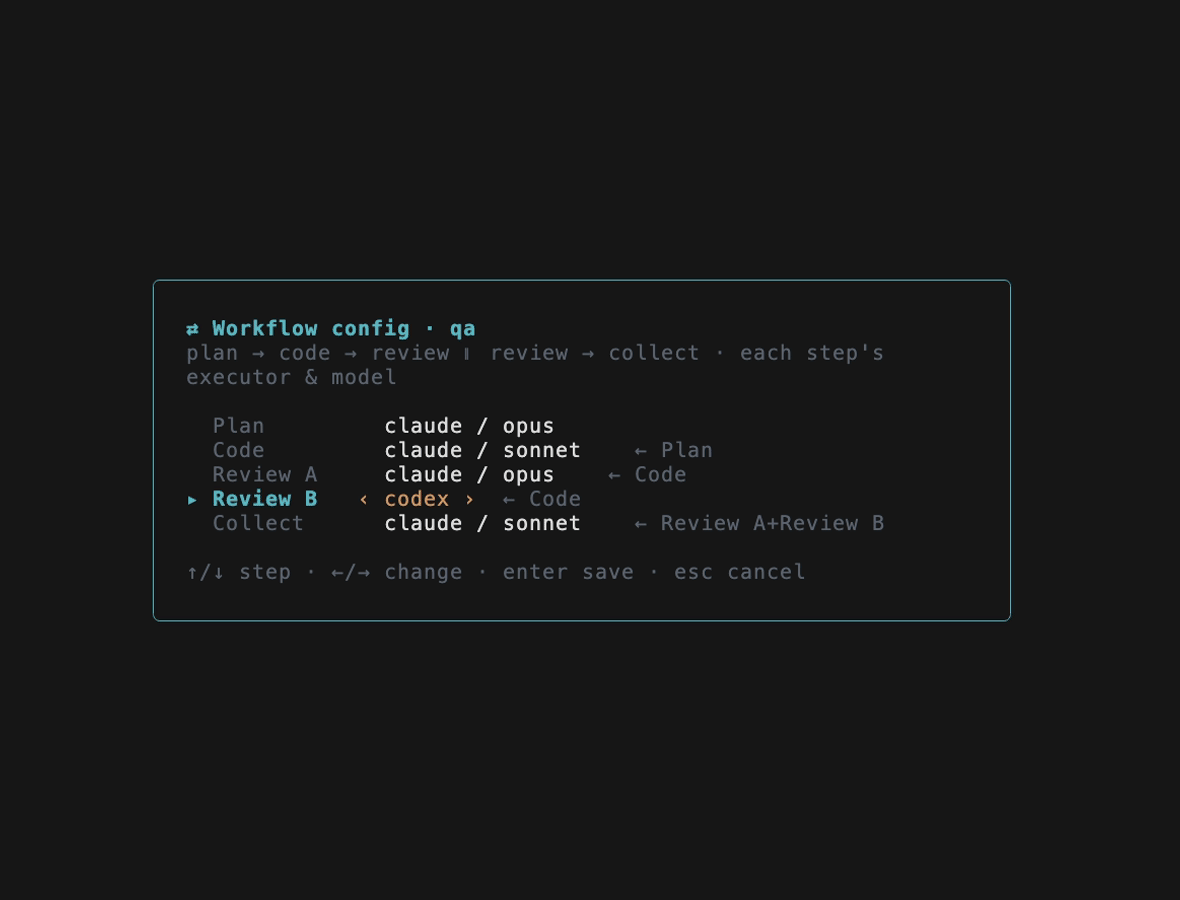
- Press `W` on the board to open a compact per-project workflow config modal:
  one row per step (Plan, Code, Review A, Review B, Collect) with a horizontal
  executor/model selector, showing each step's dependencies (← Code, ← Review
  A+Review B) so the DAG is visible. ↑/↓ pick a step, ←/→ change, enter saves.
- Saves to the same persisted per-project config as `ty pipeline config`, so a
  change here is what every workflow in the project defaults to (verified: the
  CLI reads back what the TUI writes, and vice versa).
- Prefills from the project's current effective config; project is the selected
  task's project, else the last-used project.

WorkflowConfigModel is a small self-contained bubbletea model (compact one-line
selectors, not a tall huh form). Tests cover the executor/model option list and
the value round-trip.

Co-Authored-By: Claude Opus 4.8 (1M context) <noreply@anthropic.com>
Full TUI flow for workflows — including in-TUI config (
|
… authoring

Answers "how do I define/configure the steps": custom workflows are now
first-class. You can define a whole new flow (add a QA step, a spike→build→test
shape, extra reviewers) without touching Go.

- **YAML files.** One workflow per file in ~/.config/task/workflows/*.yaml
  (override $TY_WORKFLOWS_DIR) and per-project .taskyou/workflows/. Discovered at
  runtime and merged with the built-in; a custom name shadows a built-in.
  Schema: name/description + steps[{name, executor, model, deps, prompt}].
- **Authoring is just prompts.** You write what each step does + its deps; the
  git handoff is DERIVED from the step's DAG position (compose.go): a step with a
  parallel sibling pushes to its own branch, a join reads its inputs' branches,
  the sink opens the PR. So authors never write commit/push/PR boilerplate — the
  same class of bug the earlier real-agent QA caught.
- **Free text → workflow.** `ty pipeline new "<describe it>"` runs the
  description through Claude to emit a validated YAML you can edit, with a
  self-repair retry when the model violates the single-root rule.
- `ty pipeline --list` marks built-in vs custom; custom workflows appear in the
  TUI new-task selector automatically.

Tests: YAML parse/validate/marshal round-trip, registry merge + shadowing,
DAG-derived handoff (parallel/join/sink/linear), Create honoring a custom
workflow. QA'd end-to-end: hand-written YAML + a live LLM-generated 9-step DAG
(plan → 3 parallel spikes → select → build → review∥test → finalize).

Follow-ups: multi-root workflows (true parallel entry points) still need shared-
branch bootstrapping; the TUI `W` model-config modal targets the default
definition (custom workflows configure models in their YAML / via CLI).

Co-Authored-By: Claude Opus 4.8 (1M context) <noreply@anthropic.com>
User-defined workflows — text-file first, LLM optional (
|
… (config is files)

Two follow-ups from review, done:

Multi-root workflows (true parallel entry points, e.g. 3 spikes with no shared
root) now work. When a workflow has >1 root, Create pre-creates the shared branch
on the remote so every root can check it out at once and run in parallel; the
single-root path is unchanged. hasParallelPeer treats multiple roots as peers, so
each root pushes to its own branch and the join reads them (all derived from the
DAG). validate() now accepts >=1 root; a clear error is returned if a multi-root
workflow's project has no remote.

Removed the settings-based per-project model config and its TUI form — config
lives in the YAML files now:
- Deleted internal/pipeline/config.go (StepConfig/GetConfig/SaveConfig/
  EffectiveSteps/…), the `ty pipeline config` command, and the `W` TUI modal
  (WorkflowConfigModel + all wiring). Create uses the definition's steps directly.
- To customize the built-in, `ty pipeline edit` ejects it to a YAML file (steps
  written with verbatim:true so the ejected file behaves identically); edit the
  models/prompts/steps there. A custom file shadows the built-in by name.

Tests: multi-root parse/validate + DAG-derived parallel-root handoff; removed the
config round-trip tests. QA'd: eject round-trip, multi-root create (branch
pre-created on origin, all roots queued, join blocked), and the no-remote error.

Co-Authored-By: Claude Opus 4.8 (1M context) <noreply@anthropic.com>
Both follow-ups done (
|
…w-plancodereview-multi-agent

# Conflicts:
#	internal/mcp/server.go
#	internal/ui/app.go
Add a Workflows section to the README (default plan-code-review, running via CLI/TUI, custom YAML workflows + ty pipeline new/edit), document the taskyou_create_pipeline MCP tool, and add workflow commands + the MCP tool to the taskyou skill.
The Vulnerability Check CI job (Go 1.25.11, patched stdlib) flagged GO-2026-5320 in github.com/yuin/goldmark, fixed in v1.7.17. Bump the (indirect) dependency to clear it; govulncheck now reports no vulnerabilities affecting our code.
1 participant

Workflow task type: one goal → a small DAG of steps
Adds a workflow: a single goal is broken into a small DAG of step tasks that run on one shared git branch, each routed to its own executor and model, advancing automatically. Steps are sequential where they depend on each other and parallel where they don't.
The default
plan-code-reviewworkflow:PLAN.md, push. No code.How it works
Built on primitives TaskYou already has — no bespoke execution engine; the normal daemon runs each step task:
Depsbecomeauto_queuedependencies. Fan-out (two reviewers depending on Code) and join (Collect depending on both reviewers) fall out for free —ProcessCompletedBlockerqueues a step once all its blockers complete.SourceBranch, handing work forward through git. The two reviewers push to their own branches (single push, no rebase) so they can't clobber each other, and Collect reads each explicitly.blockedwhen Collect opens the PR (awaiting a human merge) or when a step callstaskyou_needs_input.⇄ goal/Review ∥ · 3/5) instead of cluttering the board with a card per step.Configurable per project
Each step's executor and model is configurable per project and persisted, so you set it once and every workflow in that project uses your choices:
Steps are data, so a workflow can be extended (add a QA step, a third reviewer, a different flow) without touching the executor.
Entry points
ty pipeline "<goal>"(--definition,--list,--no-execute,--permission-mode,--json) andty pipeline config.taskyou_create_pipelineso an agent can spawn a workflow mid-task.Each step commits and pushes the shared branch, so a workflow needs a git-worktree project with a remote to push to.
Changes
internal/pipeline/(new/reworked): DAG model (Step+Deps, validated for single-root / acyclic / unique names), the built-inplan-code-reviewdefinition,Create()that builds the linked-task DAG, per-project step config, andGroupWorkflowsfor the collapsed board card.internal/ui/: workflow board collapse (kanban.go,app.go), the Workflow form selector, the confirm/toast.cmd/task/main.go:ty pipeline+ty pipeline config.internal/mcp/server.go:taskyou_create_pipeline.internal/executor/executor.go:setupWorktreehonors a caller-pinnedBranchNameso the root step can own the shared branch.Tests & QA
golangci-lintv2.8.0 green.Follow-ups
pipeline config(today it's the CLI; the TUI already honors the saved config).🤖 Generated with Claude Code