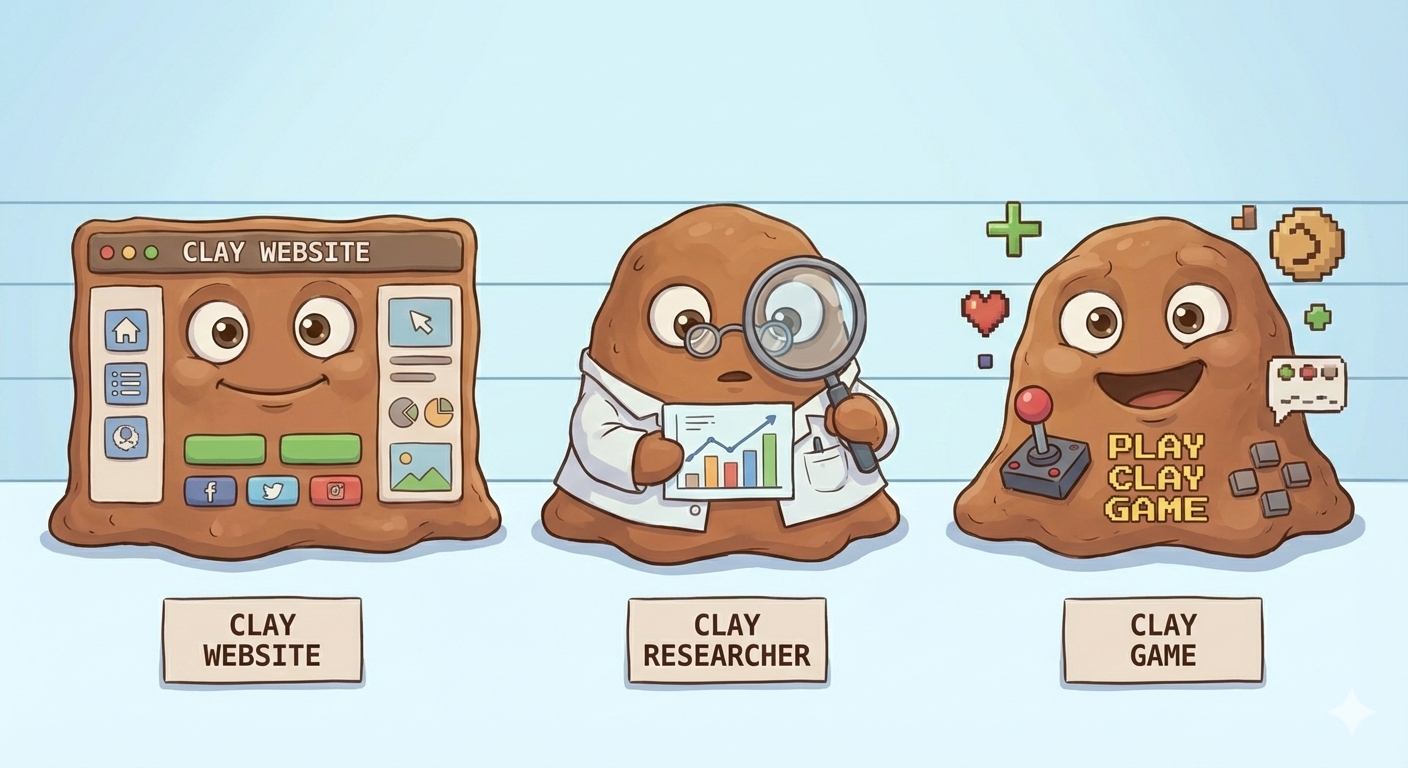
An autonomous AI agent that lives in a container. You talk to it, it changes shape.
Clay is a multi-agent orchestrator built on Google ADK that runs in an Alpine Linux container with persistent memory, identity, a public web page, and the ability to modify its own source code.
- Persistent memory — SQLite-backed with full-text search. Survives restarts.
- Identity — SOUL.md and IDENTITY.md files define who the agent is.
- Self-modification — The agent can edit its own Go source, recompile via an external build service, and hot-swap itself while running.
- Starlark extensions — Write Python-like scripts that run embedded in the Go binary. No restart needed.
- Web presence — Each container serves a public page at its subdomain.
- Messaging — Connects to Telegram via Matterbridge. Also accepts HTTP messages.
- Autonomous heartbeat — Keeps working when nobody is watching.
clay              — ADK multi-agent orchestrator (port 8081 internal)
clay-proxy        — Public HTTP proxy (port 8080 → ADK + static files)
clay-bridge       — Matterbridge ↔ ADK connector
clay-medic        — Supervisor with crash recovery + binary hot-swap
matterbridge      — Telegram bot bridge (optional)
The agent has two sub-agents: claude (coding — files, bash, builds) and research (web search + page fetching). The coordinator handles memory, identity, tasks, Starlark extensions, and platform integration.
# 1. Clone and configure
git clone https://github.com/philmade/clay.git
cd clay
cp .env.example .env
# Edit .env with your API key and model

# 2. Build and run (docker-compose.yml wires up ports + persistent volumes)
docker compose up -d --build

# 3. Talk to it
curl -X POST http://localhost:8080/msg \
  -H 'Content-Type: application/json' \
  -d '{"text": "hello, who are you?"}'
The proxy serves the public page and API on port 8080; the ADK debugger UI is on 8081.
| Variable | Required | Default | Description |
|---|---|---|---|
ANTHROPIC_API_KEY |
Yes | — | API key for the LLM backend |
ANTHROPIC_API_BASE |
No | https://api.anthropic.com |
Base URL (supports any Anthropic-compatible API) |
ANTHROPIC_MODEL |
No | claude-sonnet-4-20250514 |
Model name |
MODEL_PROVIDER |
No | anthropic |
anthropic or gemini |
TELEGRAM_BOT |
No | — | Telegram bot token (enables Telegram messaging) |
TELEGRAM_CHAT_ID |
No | — | Telegram chat ID for the bot |
CLAY_ROOT |
No | /app |
Application root directory |
CLAY_DB |
No | /app/data/messages.db |
SQLite database path |
BUILD_SERVICE_URL |
No | http://claw-build-service:9090 |
External build service for self-modification |
/app/
├── clay                  # Main agent binary
├── clay-medic            # Supervisor binary
├── clay-bridge           # Matterbridge connector
├── clay-proxy            # Public HTTP proxy
├── src/                  # Full Go source (agent can read + modify)
├── data/                 # PERSISTENT — memory, extensions, logs
│   ├── messages.db       # SQLite memory database
│   └── extensions/       # Starlark .star scripts
├── soul/                 # PERSISTENT — identity files
│   ├── SOUL.md
│   └── IDENTITY.md
├── public/               # PERSISTENT — web page
│   └── index.html
└── builds/               # Hot-swap staging area
All three must be persistent for the agent to retain its state:
| Volume | Container path | Contents |
|---|---|---|
clay-data |
/app/data |
Memory DB, Starlark extensions, build failure logs |
clay-soul |
/app/soul |
SOUL.md, IDENTITY.md (agent personality) |
clay-public |
/app/public |
Public web page, blog posts |
Clay can modify its own Go source and recompile:
- Agent edits files in
/app/src/ - Calls
build_check()to compile without deploying - Fixes errors, repeats until clean
- Calls
build_and_deploy()— sends source to build service, receives binary - Medic detects new binary, hot-swaps, watches for 30s
- If it crashes → automatic rollback to previous binary
This requires the external build service (see cmd/buildservice).
# Build locally
cd clay && go build ./...

# Cross-compile for Linux (hot-swap into running container)
cd clay && CGO_ENABLED=0 GOOS=linux go build -ldflags="-s -w" -o ../dev-builds/clay.new .MIT