C++ MIDI 2.0 platform. An idiomatic wrapper over the midi2 core. Build MIDI 2.0 devices, hosts, and bridges.
C++17, callback-first, static-by-default, bundles midi2, MIT. From DIY to professional products.






midi2cpp is the layer where a sketch meets the protocol. Plug a board into the laptop, write one short sketch, flash, and the device appears on the bus as a USB MIDI 2.0 endpoint with full Capability Inquiry, Property Exchange, and 32-bit resolution.
Underneath, midi2 (the portable C99 core) handles parsing, dispatch, and reassembly. midi2cpp adds the C++ ergonomics: callbacks, board glue, ready-made USB descriptors. The board does the talking; the sketch tells it what to say.
No external library dependency: the midi2 core is bundled. Transport, clock, and RNG are caller-supplied; no submodules.
- Quickstart
- What the library offers
- Three shapes
- Boards
- Install
- API at a glance
- Architecture
- What this library is not
- Sponsor
- About
- Specifications and trademarks
- License
In MIDI 1.0 a note has 128 velocity levels, and bending one note of a chord bends the whole channel. MIDI 2.0 gives every note 65,536 dynamic levels, its own pitch bend, and its own controllers. This is what that looks like:
#include <midi2cpp.h>
using namespace midi2;

m2device midi;

// Outbound UMP: one line per board. TinyUSB shown; see the recipes below.
size_t plat_write(const uint32_t* words, size_t count) {
  return tud_midi2_n_ump_write(0, words, count);
}

void setup() {
  midi.setWriteFn(plat_write);
  midi.begin();
}

void loop() {
  // A C major chord, each note with its own 16-bit dynamic.
  midi.noteOn(0, 60, 0x8000);   // C4, mezzo-forte
  midi.noteOn(0, 64, 0x6000);   // E4, a touch softer
  midi.noteOn(0, 67, 0xC000);   // G4, singing on top

  // Bend only the G. The C and the E hold still.
  for (uint32_t bend = 0x80000000; bend < 0x90000000; bend += 0x00800000) {
    midi.sendPerNotePitchBend(/*group*/ 0, /*channel*/ 0, /*note*/ 67, bend);
    delay(15);
  }

  // Open the same note's own brightness (per-note controller 74).
  midi.sendRegPerNoteController(0, 0, 67, 74, 0xFFFF0000);

  midi.noteOff(0, 60);
  midi.noteOff(0, 64);
  midi.noteOff(0, 67);
  delay(1000);
}
Receiving is symmetric: 49 typed callbacks, one per message kind.
midi.onNoteOn([](uint8_t ch, uint8_t note, uint16_t vel16) {
  // vel16 spans the full 16-bit range; MIDI 1.0 inputs arrive upscaled.
});
Every callback also has a verbose overload exposing Group and the MIDI 2.0 attribute fields; see API at a glance.
midi2cpp is platform-agnostic: it parses, dispatches, and assembles UMP, and leaves USB transport, clock, and entropy to the caller. The entire platform contract is four hooks (setWriteFn, feedRx, setNowFn, setMounted + setAltSetting); anything left unset degrades safely. hello-midi2-arduino is the complete compilable baseline, including the MIDI-CI responder package (Discovery, Profiles, Property Exchange, Process Inquiry) validated against the MIDI 2.0 Workbench, and the board recipes wire real transports.
- USB MIDI 2.0 device, host, or both, depending on the board.
- 49 typed UMP callbacks: notes, CCs, RPN/NRPN, per-note expression, Flex Data, Stream messages.
- MIDI-CI out of the box: Discovery, Profile negotiation, Property Exchange (with Subscribe/Notify), Process Inquiry.
- Static-by-default. The hot path is allocation-free; init-time
newonly insidem2bridgefor the per-slot tables. Fits a Cortex-M0+. - Pay-as-you-go: only the modules called by the sketch end up in the binary.
| Class | Role | Status |
|---|---|---|
m2device |
USB MIDI 2.0 device, board enumerates as a MIDI peripheral on a host (DAW, OS) | available |
m2host |
USB MIDI 2.0 host, board exposes a USB-A port and reads attached MIDI devices | available |
m2bridge |
Host + device, both ports active; route, group-rewrite, dynamic FB names, MIDI 1.0 alt 0 uplift | available |
Same callback API across the three. m2bridge composes m2device + m2ci + m2host and adds a multi-slot Stream Discovery responder, raw UMP forward with per-slot group window rewrite, and an internal ByteStreamConverter per slot for MIDI 1.0 alt 0 upstream devices. Reference platform glue at examples/esp32-p4-devkit-bridge2-midi2; the older examples/esp32-p4-devkit-bridge-midi2 and examples/adafruit-feather-rp2040-bridge-midi2 keep the same role with the slot table + responder carried inline, until they migrate to m2bridge.
Validated on real hardware against TinyUSB upstream. midi2cpp is one of several integrations of the underlying midi2 C99 core; concrete recipes for boards that use midi2cpp ship under examples/, one per role (device, host, bridge). The Notes column links each recipe and flags any board-specific build requirement.
| Board | MCU | Device | Host | Bridge | Workbench | Transport | Notes |
|---|---|---|---|---|---|---|---|
| ESP32-S3 DevKitC-1 | ESP32-S3 | ✅ | - | - | ✅ | TinyUSB | esp32-s3-devkitc-usb-midi2 |
| Arduino Nano ESP32 | ESP32-S3 | ✅ | - | - | ✅ | TinyUSB | arduino-nano-esp32-midi2 |
| Waveshare ESP32-P4-WIFI6-DEV-KIT (device) | ESP32-P4 | ✅ | - | - | ✅ | TinyUSB | esp32-p4-devkit-usb-midi2, mandatory LP_SYS.usb_ctrl PHY swap |
| Waveshare ESP32-P4-WIFI6-DEV-KIT (host / bridge) | ESP32-P4 | - | ✅ | ✅ | - |  TinyUSB TinyUSB |
esp32-p4-devkit-host-midi2, esp32-p4-devkit-bridge-midi2, esp32-p4-devkit-bridge2-midi2, experimental coexistence branch |
| LilyGo T-Display S3 | ESP32-S3 | ✅ | - | - | ✅ | TinyUSB | t-display-s3-midi2, full UMP receiver, on-board ST7789 piano roll |
| T-Display S3 AMOLED | ESP32-S3 | ✅ | ✅ | - | - | TinyUSB | uses the library directly, no dedicated recipe yet |
| Teensy 4.1 | i.MX RT1062 | ✅ | ✅ | - | ✅ |  Teensyduino native + USBHost_t36 Teensyduino native + USBHost_t36 |
teensy41-midi2 (device), teensy41-control-surface, teensy41-host-midi2, Teensyduino cores + USBHost_t36 forks |
| Daisy Seed | STM32H750 | ✅ | ✅ | - | - | libDaisy native |
daisyseed-midi2 (device), daisyseed-host-midi2 (host), libDaisy fork, STM32 HAL stack |
| Raspberry Pi Pico | RP2040 | ✅ | - | - | ✅ | TinyUSB | rp2040-midi2 |
| Waveshare RP2040 Pi Zero | RP2040 | ✅ | - | - | ✅ | TinyUSB | waveshare-rp2040-midi2 |
| Adafruit Feather RP2040 USB Host | RP2040 | ✅ | ✅ | ✅ | - | TinyUSB, PIO-USB | adafruit-feather-rp2040-host-midi2, adafruit-feather-rp2040-bridge-midi2, Pico-PIO-USB 675543b |
| RP2040 Pro Micro (Tenstar Robot) | RP2040 | ✅ | - | - | ✅ | TinyUSB | rp2040-promicro-ump-test-bench, deterministic UMP emitter for Windows MIDI Services testing |
| Waveshare RP2350-USB-A | RP2350 | ✅ | ✅ | ✅ | ✅ | TinyUSB, PIO-USB on GP12/GP13 | waveshare-rp2350-usb-a-midi2 (device), waveshare-rp2350-usb-a-bridge-midi2 (bridge), R13 hardware mod for host mode |
| Raspberry Pi Pico 2 | RP2350 | ✅ | - | - | ✅ | TinyUSB | rp2350-pico2-midi2 |
| ESP32-C6-DevKitC-1 | ESP32-C6 |  |
- | - | - | BLE-MIDI 1.0 + ESP-NOW | esp32-c6-devkitc-multi-midi2, wireless (BLE-MIDI + ESP-NOW), no USB-OTG |
| nRF52840 Pro Micro (Nice!Nano class) | nRF52840 | ✅ | - | - | ✅ | TinyUSB | nrf52840-promicro-midi2, TinyUSB native CMake build |
| Seeed XIAO SAMD21 | SAMD21 | ✅ | - | - | - | TinyUSB | xiao-samd21-midi2, TinyUSB native CMake build |
| T-PicoC3 (RP2040 side) | RP2040 + ESP32-C3 | ✅ | - | - | ✅ | TinyUSB | t-picoc3-device-midi2, on-board LCD visualizer (LovyanGFX) |
| WeAct RA4M1 64-Pin Core Board | RA4M1 | ✅ | - | - | ✅ | TinyUSB | ra4m1-weact-device-midi2, board overlay for bootloader-less 0x0 flash |
| WeAct STM32F411 BlackPill | STM32F411 | ✅ | - | - | ✅ | TinyUSB | weact-STM32F411CEU6-blackpill-device-midi2, native OTG_FS, CMake build |
Workbench ✅ marks a device recipe validated against the official MIDI 2.0 Workbench: it completes the self-certification checklist for the features it implements (MIDI-CI Discovery, Profile Configuration, Property Exchange, Process Inquiry, plus the UMP message categories the recipe emits). A blank cell means the recipe has not been run through the Workbench yet, not that it fails.
The library itself carries no external dependencies; a handful of recipes pin theirs. The PIO-USB host recipes (adafruit-feather-rp2040-host-midi2, adafruit-feather-rp2040-bridge-midi2, waveshare-rp2350-usb-a-bridge-midi2) pin Pico-PIO-USB at upstream SHA 675543b, the merge commit of PR #186 "reduce handshake delay", required for MIDI 2.0 host enumeration over PIO-USB (merged upstream, newer than the latest tagged release 0.7.2; the pin becomes a plain version bump once upstream tags a new release). The Teensy recipes build against two forks carrying code not yet submitted upstream: sauloverissimo/cores branch feature/usb-midi2-descriptors (native USB MIDI 2.0 with AS0 + AS1 alt settings, used by teensy41-midi2 and teensy41-control-surface) and sauloverissimo/USBHost_t36 branch feature/midi2-host-base (USB MIDI 2.0 host side, used by teensy41-host-midi2). Each fork retires when its changes land upstream.
29 recipes ship under examples/, grouped by build path:
| Build system | Count | Recipes |
|---|---|---|
| Pico SDK | 9 | rp2040-midi2, waveshare-rp2040-midi2, rp2350-pico2-midi2, waveshare-rp2350-usb-a-midi2, waveshare-rp2350-usb-a-bridge-midi2, adafruit-feather-rp2040-host-midi2, adafruit-feather-rp2040-bridge-midi2, rp2040-promicro-ump-test-bench, t-picoc3-device-midi2 |
| ESP-IDF | 7 | arduino-nano-esp32-midi2, esp32-s3-devkitc-usb-midi2, esp32-p4-devkit-usb-midi2, esp32-p4-devkit-host-midi2, esp32-p4-devkit-bridge-midi2, esp32-p4-devkit-bridge2-midi2, t-display-s3-midi2 |
| PlatformIO + ESP32_Host_MIDI | 3 | esp32-c6-devkitc-multi-midi2, esp32-s3-devkitc-host-midi2, t-display-s3-shield-host-midi2 |
| TinyUSB native CMake | 4 | xiao-samd21-midi2, nrf52840-promicro-midi2, ra4m1-weact-device-midi2, weact-STM32F411CEU6-blackpill-device-midi2 |
| Arduino IDE / arduino-cli | 4 | teensy41-midi2, teensy41-control-surface, teensy41-host-midi2, hello-midi2-arduino |
| libDaisy / Makefile | 2 | daisyseed-midi2, daisyseed-host-midi2 |
By role: 16 device, 6 host, 4 bridge, 1 multi-transport (BLE + ESP-NOW, no USB PID), 1 deterministic UMP test bench, 1 transport-agnostic starter (hello-midi2-arduino).
Listed on the Arduino Library Manager. The IDE install path: search the manager, click Install. That is the only library you install; the midi2 core is bundled.
Manual install (mirror, or while the manager index is propagating):
git clone https://github.com/sauloverissimo/midi2cpp.git ~/Arduino/libraries/midi2cppPublished on the PlatformIO Registry:
lib_deps = sauloverissimo/midi2cpp @ ^0.6.1Or pin by git tag:
lib_deps =
  https://github.com/sauloverissimo/midi2cpp.git#v0.6.1
That is all you need: midi2cpp bundles the midi2 C99 core, so there is no separate midi2 dependency to install.
Published on the ESP Component Registry. Two install paths, depending on whether midi2cpp comes from the registry or lives inside the project tree:
Via the Component Manager (recommended):
# main/idf_component.yml
dependencies:
  idf: ">=5.0"
  sauloverissimo/midi2cpp: ">=0.6.1"
The midi2 core is bundled inside midi2cpp, so nothing else is declared. idf.py reconfigure drops midi2cpp into managed_components/.
As a local component (useful when iterating on the wrapper):
# from your IDF project root
git clone https://github.com/sauloverissimo/midi2cpp.git components/midi2cpp
main/CMakeLists.txt lists midi2cpp in its idf_component_register(... REQUIRES midi2cpp ...) block. The seven ESP-IDF recipes under examples/ ship working templates for device, host and bridge roles.
include(FetchContent)
FetchContent_Declare(
    midi2cpp
    GIT_REPOSITORY https://github.com/sauloverissimo/midi2cpp.git
    GIT_TAG        v0.6.1
)
FetchContent_MakeAvailable(midi2cpp)
midi2cpp is self-contained: the midi2 C99 core is vendored in its src/, so there is no second FetchContent or find_package to wire. A standalone midi2 install (for direct C use or other wrappers) coexists with it: a sketch or target that includes only <midi2cpp.h> uses the bundled core, and the linker does not pull a separate midi2 copy. If you deliberately link both a bundled and a different-version standalone midi2 in one binary, the linker resolves the core from one of them by link order (a consistent version, not a per-function mix).
git submodule add https://github.com/sauloverissimo/midi2cpp.git external/midi2cppDownload the midi2cpp repository, add midi2cpp/src/ to the include path, and compile src/midi2.c (the bundled midi2 core), src/midi2_device.cpp, src/midi2_ci.cpp, and the host/bridge .cpp files you need alongside the project. One repository, no package manager, nothing else to download.
m2device midi;

midi.begin();

// Inbound: Arduino-style, just the channel, note, velocity.
midi.onNoteOn ([](uint8_t ch, uint8_t note, uint16_t vel) { /* ... */ });
midi.onNoteOff([](uint8_t ch, uint8_t note, uint16_t vel) { /* ... */ });
midi.onCC     ([](uint8_t ch, uint8_t idx, uint32_t val) { /* ... */ });
midi.onPitchBend([](uint8_t ch, uint32_t val) { /* ... */ });

// Outbound: same shape, no group prefix, 32-bit values.
midi.noteOn (0, 60, 0xC000);
midi.noteOff(0, 60);
midi.cc     (0, 7, 0x80000000);
midi.pitchBend(0, 0x80000000);

midi.task();
Async, callback-first, copy-paste-ready. Same shape as MIDI 1.0 Arduino libraries, with MIDI 2.0 resolution underneath.
Need full spec fidelity? Every callback and sender has a verbose form that exposes Group, MIDI 2.0 attribute type/data, and other Multi-Group Endpoint controls; see midi2_device.h. The simple and verbose forms share storage; the latest setter wins.
midi2cpp: platform layer of a 4-layer MIDI 2.0 stack:
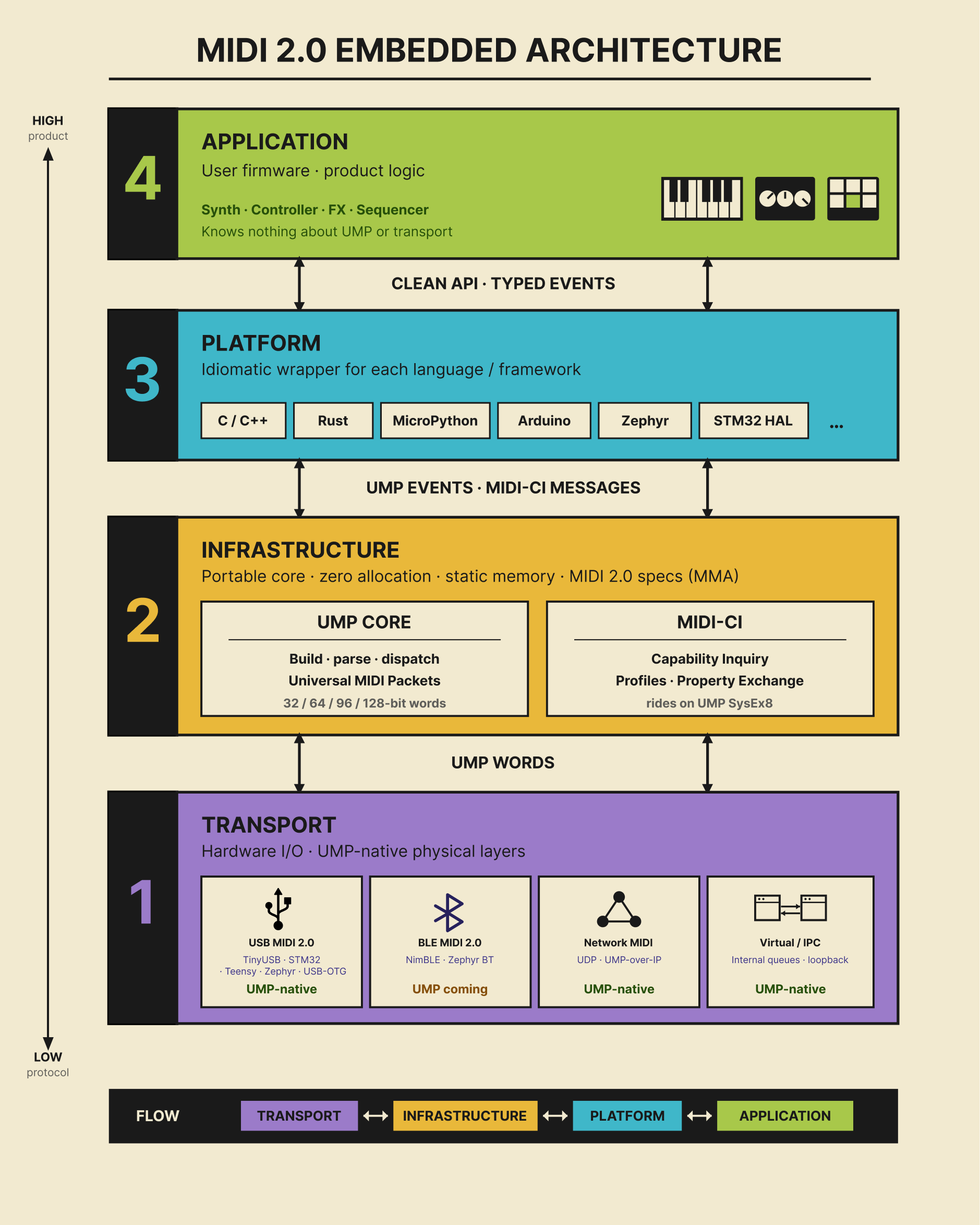
The sketch touches the top. The rest is invisible until needed.
The boundary is drawn so the wrapper stays focused. A few things deliberately do not belong here.
- Not a low-level UMP parser. That is
midi2. midi2cpp wraps it and adds C++ ergonomics; if a project wants zero-overhead C with no callbacks, linkingmidi2directly is the right move. - Not a synthesizer. UMP arrives, callbacks fire, the sketch decides what to play. Sound generation is application territory.
- Not a desktop library. It targets MCU boards. It compiles on desktop for tests, but the API and memory model assume embedded constraints.
- Not opinionated about transport. TinyUSB, native USB (Teensy), PIO-USB (RP2350), STM32 HAL (Daisy), BLE: midi2cpp does not bring any of them with it. The sketch wires whichever transport its platform already ships.
You can sponsor midi2cpp at GitHub Sponsors. Sponsorship funds boards for cross-platform validation, spec access, and continued maintenance.
midi2cpp is created and maintained by Saulo Veríssimo. It is the C++17 sibling of midi2, the portable C99 core, and every recipe in this repository has been validated on the physical board it targets.
The MIDI 2.0 specifications referenced here are copyright of the MIDI Association and available at https://midi.org/midi-2-0.
"MIDI" is a registered trademark of the MIDI Manufacturers Association (now MIDI Association). "MIDI 2.0", "MIDI-CI", and "UMP" are terms defined by the MIDI Association in the public specifications.
MIT. Free for commercial and open-source use, in any context.