
MakeHDR is an OpenFX plug-in for merging multiple LDR images into a single HDRI.
- Merge up to 16 inputs with 8, 10 or 12 bit depth processing
- User-friendly logarithmic tone-mapping controls
- Advanced controls such as sampling rate and smoothness
Available cross‑platform on Linux, macOS, and Windows; works consistently in compositing applications such as Nuke, Fusion, and Natron.
Download the latest release and copy the MakeHDR.ofx.bundle directory to your custom OFX_PLUGIN_PATH or your system's default OpenFX plugin folder:
- Linux:
/usr/OFX/Plugins - macOS:
/Library/OFX/Plugins - Windows:
C:\Program Files\Common Files\OFX\Plugins
- Create a
MakeHDRnode within your DCC app. - Connect your source images, shot with multiple shutter speeds.
- Fill in the exposure times in seconds for the appropriate inputs (e.g., for a 1/250 shutter speed, enter 0.004).
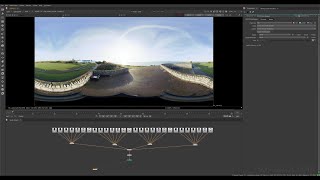
If you prefer to compile the plugin yourself, ensure you have CMake ≥ 3.5 and a C++14-compatible compiler ready on your system. Then run:
git clone --recursive https://github.com/sosoyan/make-hdr.git
cd make-hdr && mkdir build && cd build
cmake .. && sudo make install| Parameter | Description |
|---|---|
calibrate response |
Estimates the non-linear response curve from the source images. When disabled, assumes the source images are already linear. |
1–16 |
Defines the exposure time in seconds for each corresponding connected image source. |
| Parameter | Description |
|---|---|
target middle gray |
Automatically adjusts global exposure so the average scene luminance matches the middle gray value. |
middle gray |
Defines a reference gray from the scene (e.g., sampled from a colour checker) to scale the merged image's luminance. |
exposure |
Applies a global exposure adjustment in stops to the merged HDR image before tone mapping. |
gamma |
Applies a gamma exponent per-pixel after HDR merging, where 1.0 keeps linear output. |
highlights |
Blends between fully compressed (0) and uncompressed linear (1) output. Lower values roll off bright areas more aggressively. |
| Parameter | Description |
|---|---|
show samples |
Displays the sample positions on the output image as bright green pixels. |
samples |
Defines the number of calibration samples. For Debevec, it specifies the exact number of points. For Robertson, the value is multiplied by 100 to compensate for sparse bin coverage. |
solver |
Debevec solves a linear system (fast, sparse samples). Robertson uses an iterative expectation-maximisation approach. |
smoothness / iterations |
For Debevec, higher values force a smoother response curve. For Robertson, it sets the maximum number of expectation-maximisation iterations. |
input depth |
Determines the internal histogram resolution (256, 1024, or 4096 bins). Match this to your camera's original bit depth. |
log level |
Controls plugin logging verbosity. off silences all logging, while debug prints detailed per-frame diagnostics. |