An open execution engine for AI agent loops. Loop Engineering teaches you how to design loops that prompt your agents.
loop-runtimeactually runs them — with a budget circuit-breaker, maker/checker sub-agents, worktree isolation, and human gates as first-class runtime primitives.


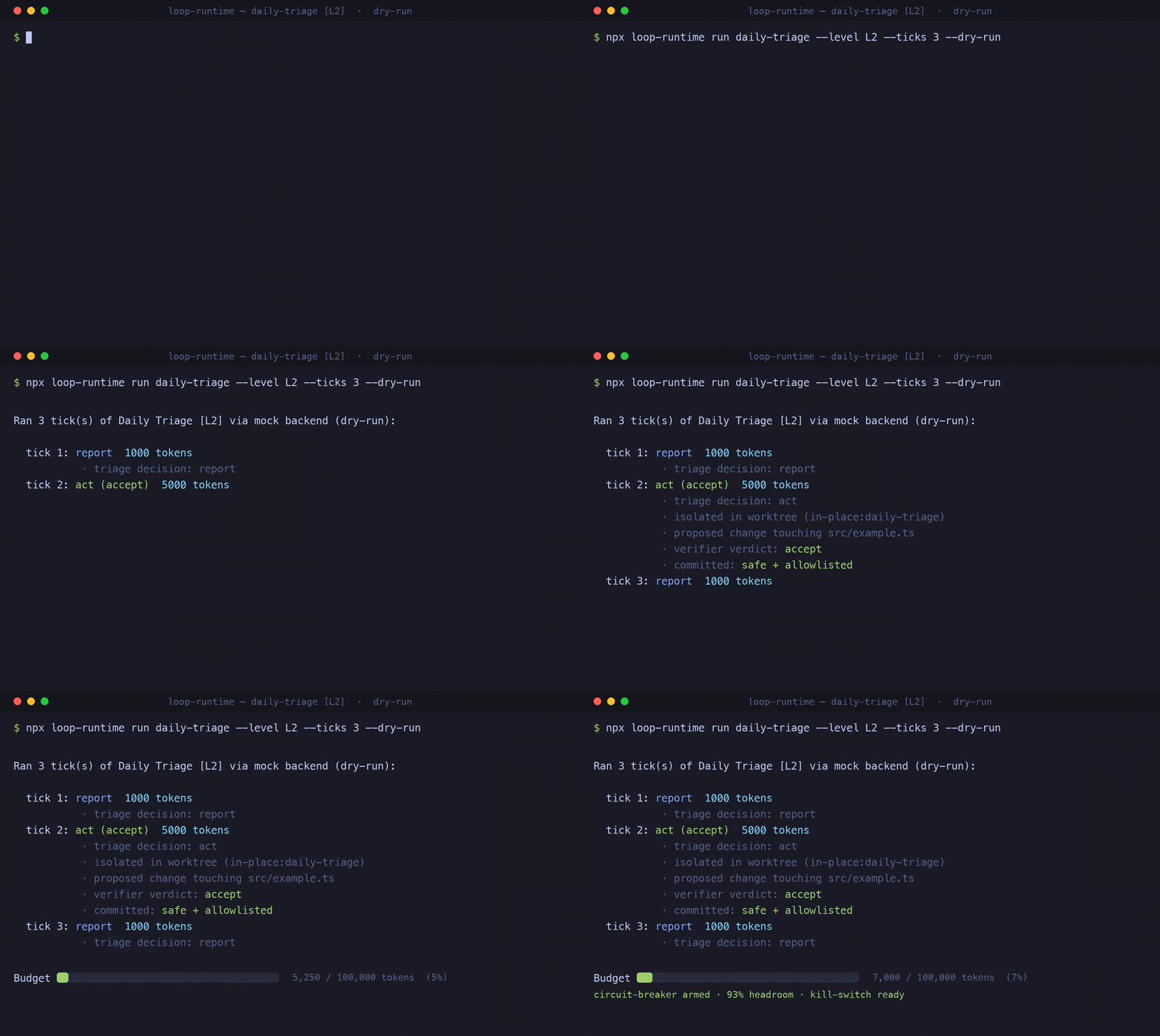
One real tick (mock backend, dry-run) — rendered from the actual CLI output by scripts/render_demo_gif.py.
# zero install, no API key — runs the engine end-to-end with a mock backend
npx loop-runtime run daily-triage --level L2 --dry-run
Ran 1 tick(s) of Daily Triage [L2] via mock backend (dry-run):
tick 1: act (accept) — 5000 tokens
· triage decision: act
· proposed change touching src/example.ts
· verifier verdict: accept
· committed: safe + allowlisted
Budget: 5,000 / 100,000 tokens spent today.
The loop-engineering ecosystem gives you the methodology and static tooling (loop-audit, loop-init, loop-cost) — all read-only or scaffolding. Nothing actually executes a loop. loop-runtime is that missing runtime. It consumes the same registry.yaml single source of truth, so it drops into an existing loop-engineering project with no new config.
flowchart LR
    A[Scheduler] --> B[Triage]
    B --> C{decision}
    C -->|noop / report| S[Write STATE + run-log]
    C -->|act| D[Worktree]
    D --> E[Implementer sub-agent]
    E --> F[Verifier sub-agent<br/>tests + gates]
    F -->|reject| X[Discard worktree]
    F -->|accept| G{Human gate}
    G -->|safe / allowlisted| I[Commit / PR]
    G -->|risky / denylisted| J[Escalate to human]
    I --> S
    J --> S
    S --> A
    B -.budget circuit-breaker.-> K[(Halt if over cap<br/>or kill-switch)]
Every box above is a real module — this is the loop-engineering "Anatomy of a Loop" diagram turned into running code.
| Those frameworks | loop-runtime | |
|---|---|---|
| Goal | build an agent app | operate a long-running, file-driven loop |
| Config | Python graphs / code | LOOP.md + registry.yaml (declarative) |
| Cost control | DIY | budget circuit-breaker + kill-switch built in |
| Safety | DIY | denylist/allowlist human gates + worktree isolation |
| Autonomy | all-or-nothing | phased L0→L3 enforced as a runtime guardrail |
| Verification | DIY | maker/checker split is the default execution shape |
# CLI
npx loop-runtime list                          # show patterns from registry.yaml
npx loop-runtime plan daily-triage --level L1  # resolve a runnable execution plan
npx loop-runtime run  ci-sweeper  --dry-run    # run tick(s) with the mock backend
As a library:
import { LoopEngine, buildPlan, BudgetBreaker, MemoryStateWriter, MockBackend } from 'loop-runtime';

const plan = buildPlan(pattern, { level: 'L2' });
const engine = new LoopEngine(plan, {
  backend: new MockBackend(),           // swap for the Claude Code backend
  state: new MemoryStateWriter(),
  budget: new BudgetBreaker(plan.dailyTokenCap),
});
const result = await engine.tick(); // structured, loggable TickResult| Module | Responsibility |
|---|---|
src/planner.ts |
registry.yaml + level → ExecutionPlan (cadence, cap, action policy) |
src/engine.ts |
one loop tick: discover → triage → implement → verify → gate → commit/escalate |
src/budget.ts |
token circuit-breaker, daily roll-over, kill-switch |
src/gates.ts |
denylist/allowlist human-gate policy, max-attempt limits |
src/state.ts |
durable spine — writes STATE.md + appends loop-run-log.md |
src/worktree.ts |
git worktree isolation — throwaway branch per act-attempt, discarded on reject/escalate |
src/backends/ |
pluggable AgentBackend — mock (deterministic) + claude (headless claude CLI) |
src/yaml.ts |
dependency-free registry reader (keeps npx install-free) |
The engine layer is I/O-free: it operates on plain types and delegates all side effects (LLM calls, git, fs) to injected collaborators. That's why the whole loop is testable end-to-end with the deterministic mock backend and zero token spend.
- Phase 1 — Engine MVP: planner, scheduler-ready ticks, budget breaker, gates, mock backend, CLI
- Phase 2 — Isolation & real backend: git worktree isolation, Claude Code backend (
--backend claude),--worktreeflag - Phase 2b — Visibility: local dashboard (cost burn-down, live loops, kill button)
- Phase 3 — Ecosystem: Codex/Grok backends, Slack/Discord notifiers, MCP connectors, GitHub Action distribution
See DESIGN.md for the full design.
node --test test/*.test.ts   # zero-install: Node >= 23.6 runs TypeScript natively
npm test
npm run demoMIT