
eXtensible SVG — an XML graphics format that compiles to plain SVG
The text layout, live diagrams & mesh gradients SVG never shipped.



You author a superset of SVG — plain XML with a handful of x:-prefixed extensions — and
xsvg compiles it to a plain, static SVG file. No runtime, no script, no editor: the output
opens anywhere an SVG does.
The extensions add the things SVG never got — real text layout (wrapping, justification,
shrink-to-fit, flow into any shape), envelope warps, boolean path algebra, offsets, re-routing
connectors, gradient meshes, and a data-coordinate frame for charts. Every one of them lowers
to primitives SVG already renders: <path>, <text>, <image>, gradients.
It's degradation-safe by construction. The x: tags live in their own XML namespace, so a
viewer that doesn't understand them simply skips them — the file never breaks. You compile when
you want the effects baked in.
<!-- author this… -->                     <!-- …get plain SVG -->
<x:pie cx="60" cy="60" r="50">      →     <path d="M60,10 A50,50 0 0 1 …Z" fill="#6366f1"/>
  <x:slice value="40"/>                   <path d="M60,60 L60,10 A50,50 …Z" fill="#0ea5e9"/>
  <x:slice value="60" fill="#0ea5e9"/>    …
</x:pie>Two npm packages, a CLI, and a VS Code extension — all over one compiler.
Browser — @visioncortex/xsvg-viewer: the WASM compiler plus a
drop-in preview surface.
npm install @visioncortex/xsvg-viewerimport { compileXsvg, createPreview } from "@visioncortex/xsvg-viewer";
el.innerHTML = await compileXsvg(source); // → a plain-SVG string
// …or a self-contained preview (fit-to-contain, + a slide deck for multi-artboard docs):
createPreview(host, { hashDeepLink: true }).render(source);The same package also ships an embeddable viewer: an <xsvg-view> custom element
(/element), a React component (/react), and a single-file <script> bundle
(dist/xsvg.js, WASM inlined) for drop-in use with no build step.
Node — @visioncortex/xsvg-compile: the same compiler, no browser.
npm install @visioncortex/xsvg-compileimport { compile } from "@visioncortex/xsvg-compile";
import { writeFileSync } from "node:fs";
writeFileSync("out.svg", compile(source, { fontDir: "./fonts" })); // synchronousCLI — a pure-Rust binary, no browser:
cargo install --path crates/xsvg-cli
xsvg deck.xsvg --font-directory ./fonts -o deck.svg
VS Code — xsvg viewer:
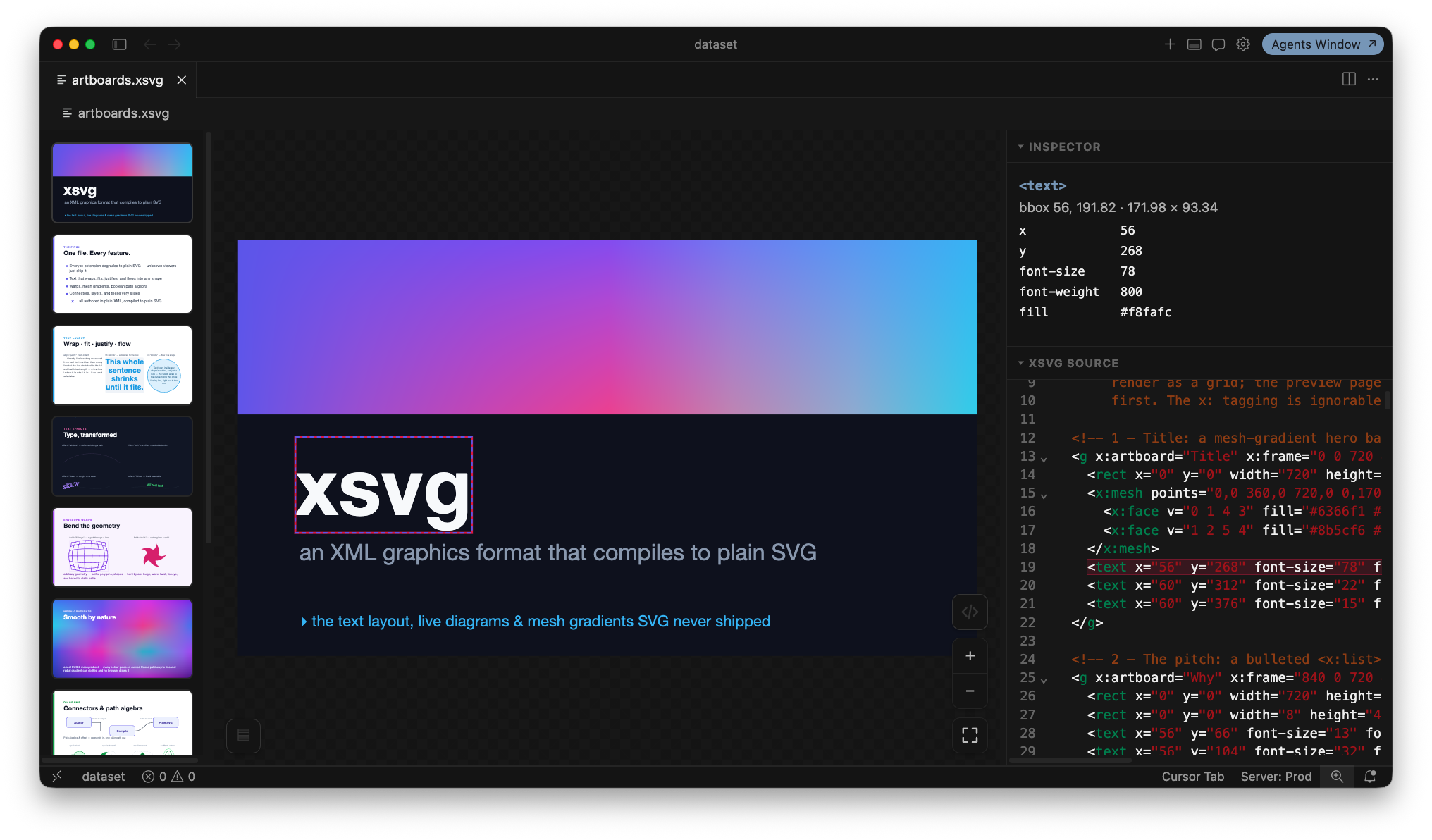
open a .xsvg and preview it live beside the source, with pan/zoom and the element inspector.
A tour of the x: extensions. Every example is real xsvg that compiles to the image beside it.
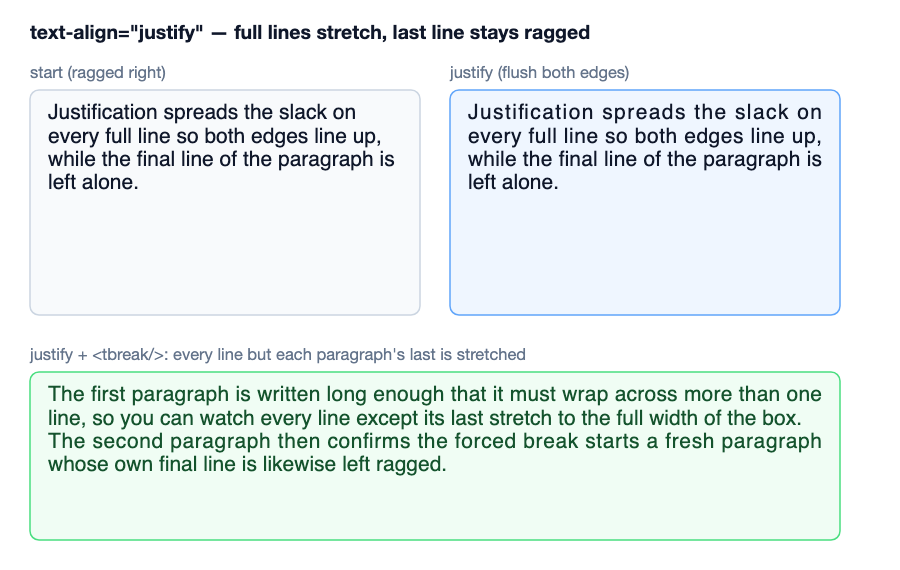
SVG has no line breaking. xsvg lays text out from real font metrics: greedy wrapping, full justification, shrink-to-fit, and — the party trick — flowing text inside any shape's outline, not just a rectangle.
<circle id="cir" cx="120" cy="120" r="90"/>
<x:textbox in="#cir" align="center" valign="middle">
  Text flows inside any shape's outline, wrapping to the curve line by line, out to the rim.
</x:textbox>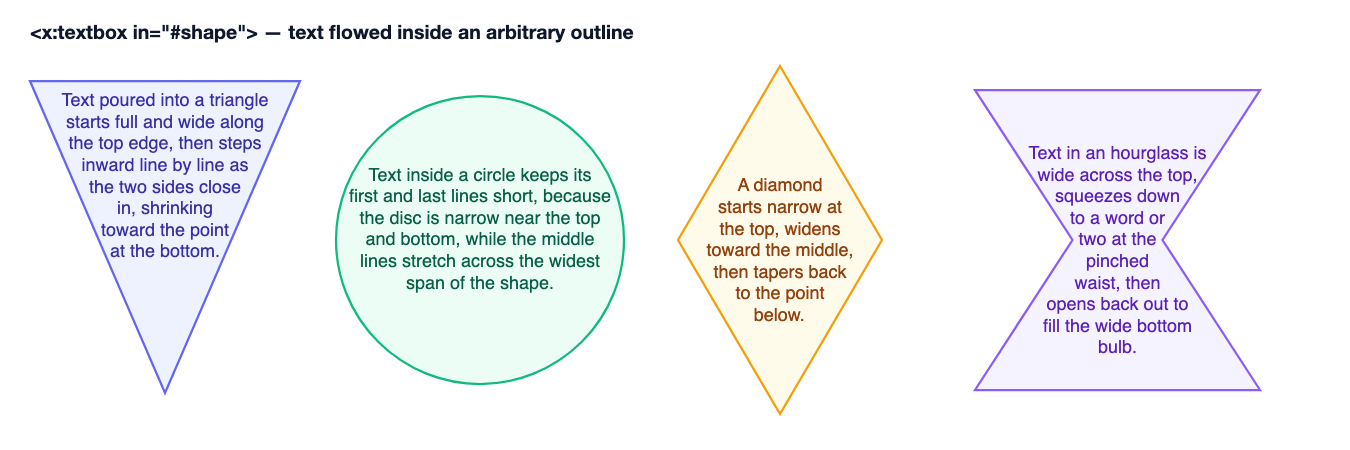
Ride text along any curve. effect="follow" is a live, selectable native <textPath>; skew
and ribbon deform the glyphs along the curve (verticals upright, or tilting with the path).
<path id="w" d="M40,120 C160,40 320,200 460,120"/>
<x:textpath in="#w" effect="ribbon" font-family="-x-google-Anton" font-size="34">RIBBON</x:textpath>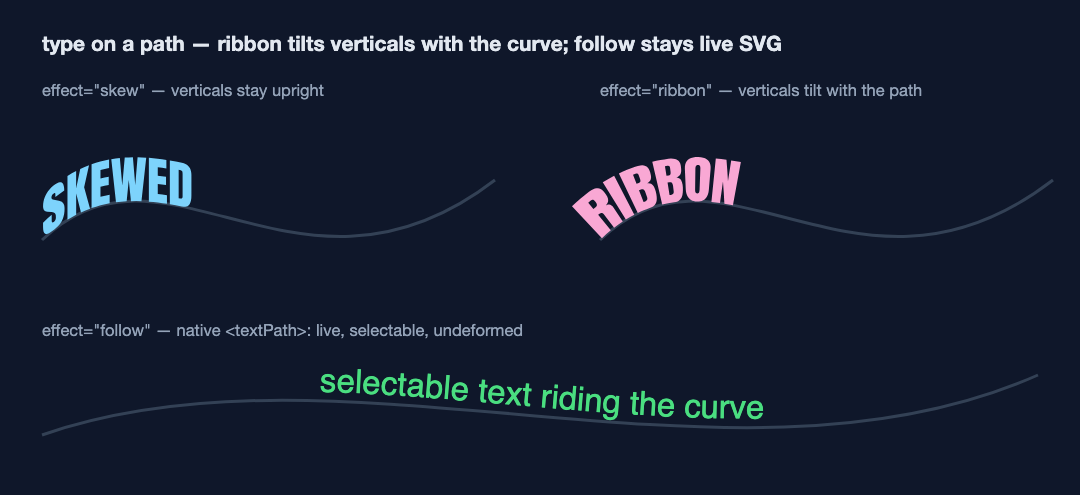
Illustrator-style envelope distortion — bend shapes and outlined text through arch, flag, rise, fisheye, perspective, and free-distort fields.
<x:warp field="arch" bend="60">
  <rect x="0" y="0" width="200" height="70" rx="8"/>
</x:warp>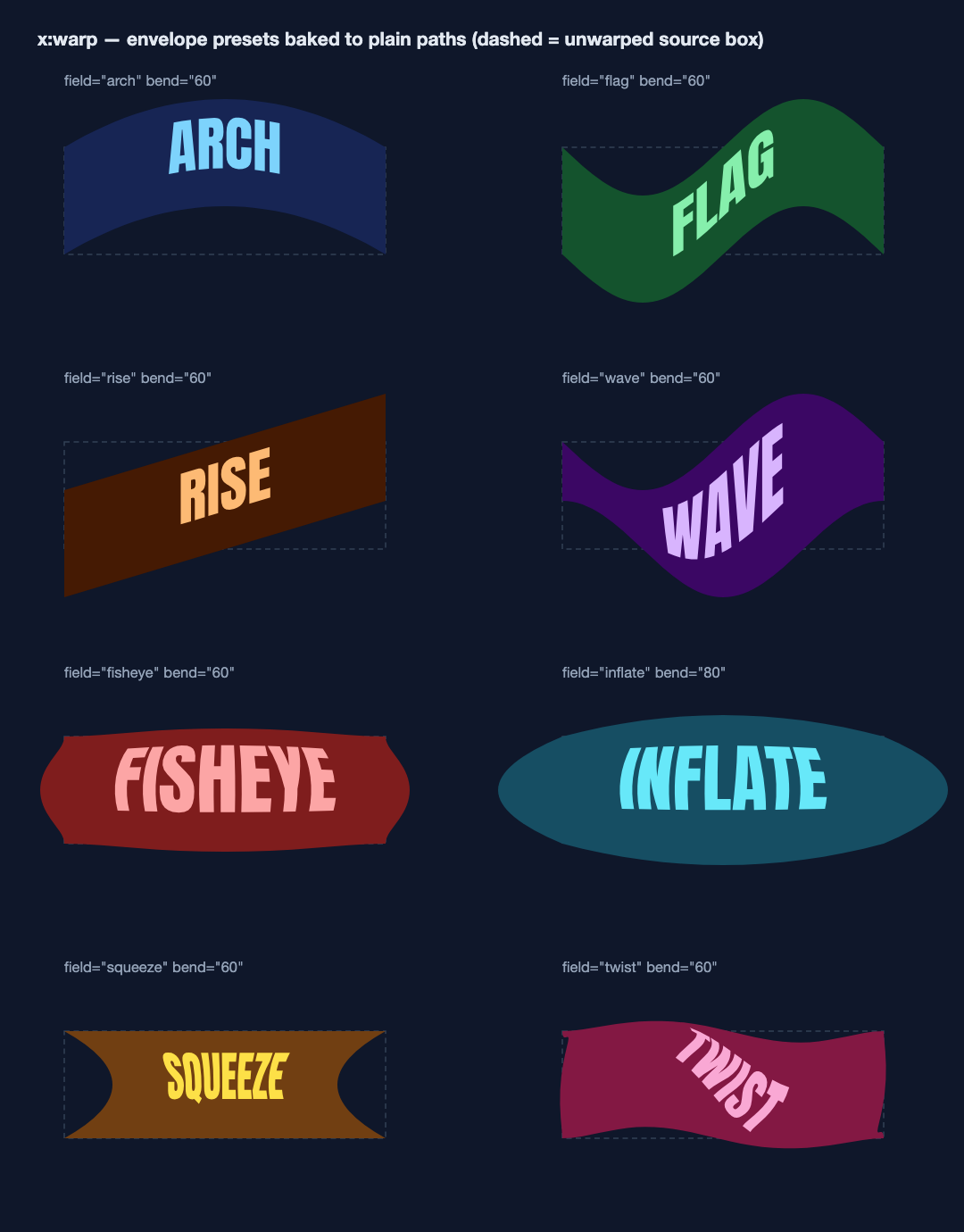
Corner colours on a quad/tri mesh — the smooth multi-focal blends no linear or radial gradient can
express. SVG 2 specified <meshgradient>, but no browser draws it; xsvg bakes it to a tiny
texel-aligned PNG that the renderer's own bilinear filter reconstructs. Inkscape/SVG-2
<meshgradient> input is accepted too.
<x:mesh points="0,0 200,0 200,120 0,120">
  <x:face v="0 1 2 3" fill="#f59e0b #ec4899 #6366f1 #10b981"/>
</x:mesh>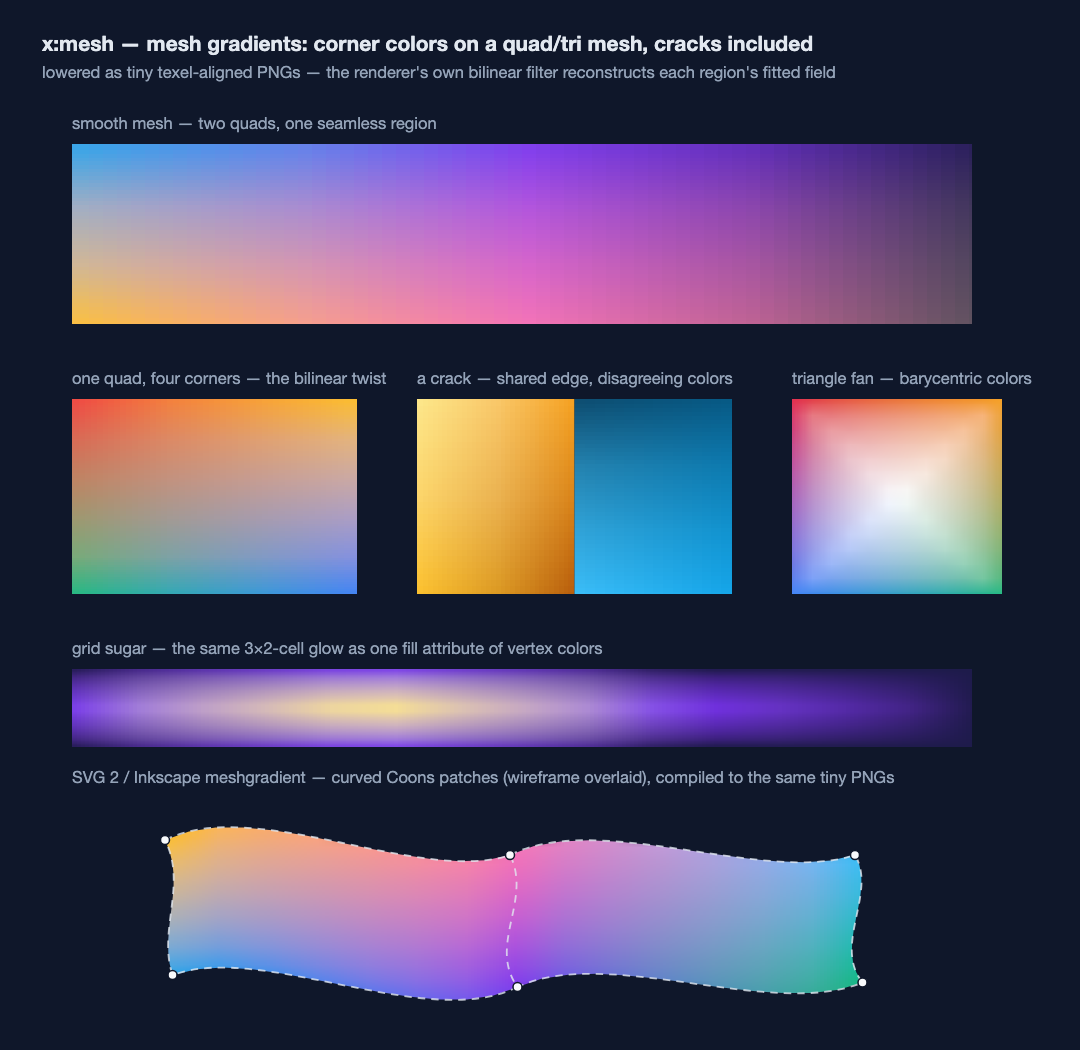
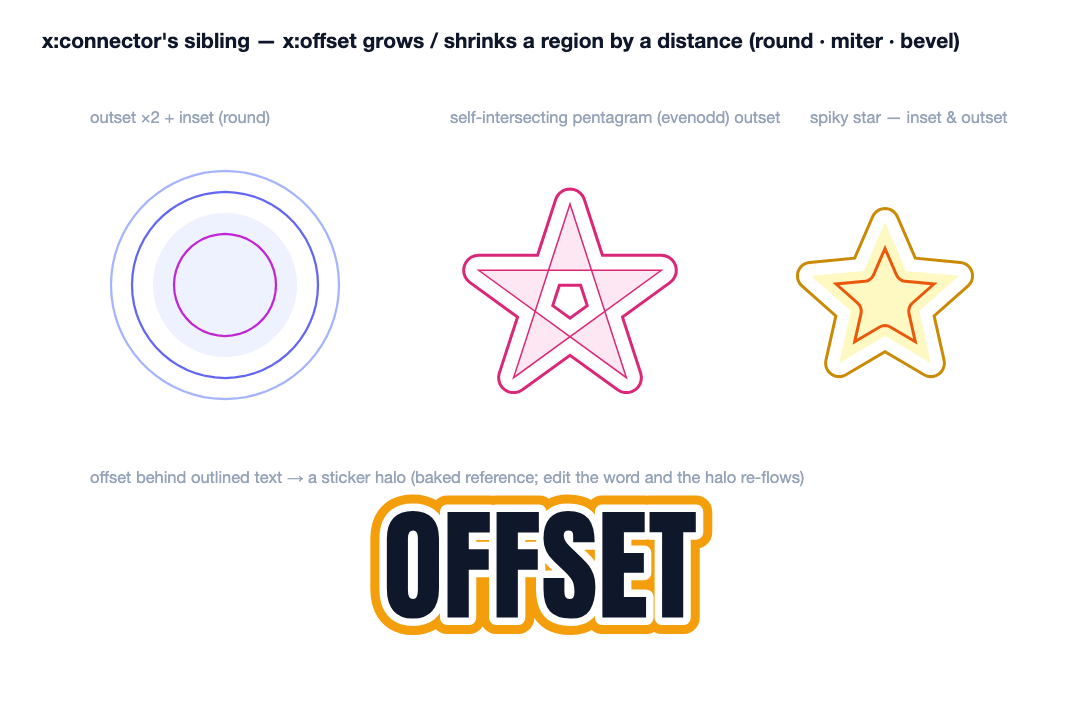
<x:connector> routes a line between two elements' edges and re-derives when a box moves
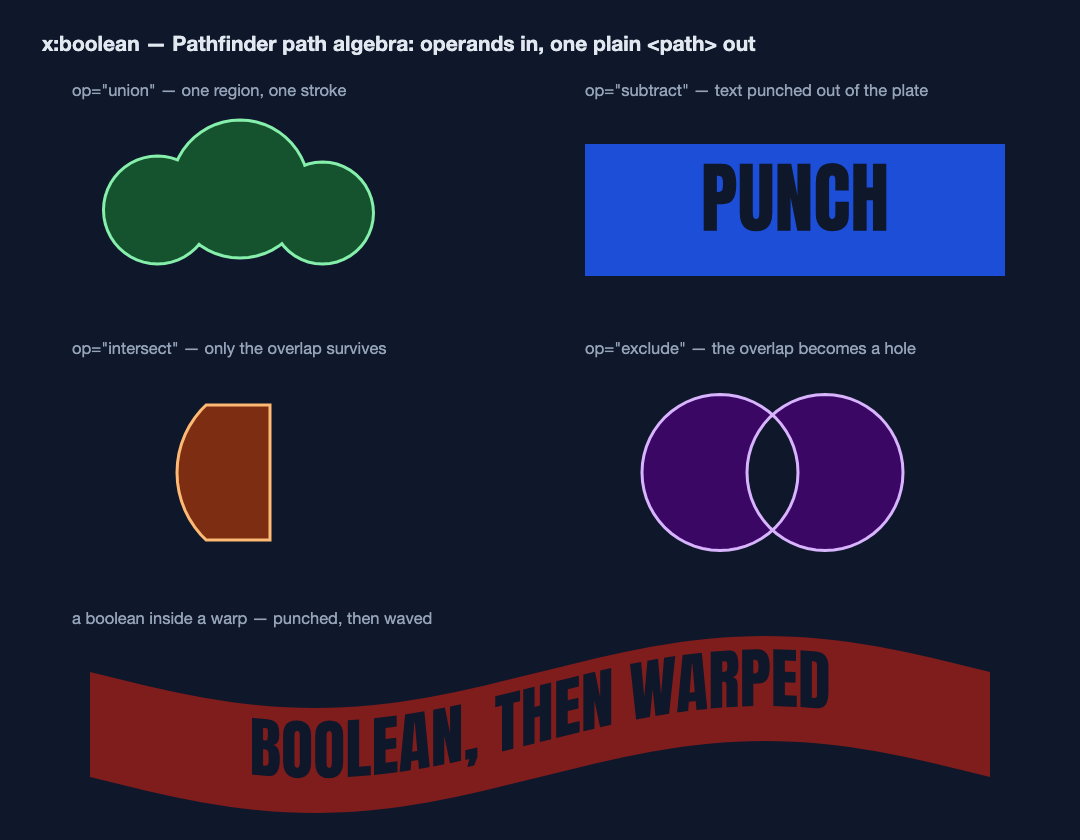
(straight, orthogonal rails, or a curve; arrowheads baked). <x:boolean> is Pathfinder-style path
algebra (union · subtract · intersect · exclude); <x:offset> grows or shrinks a region by a
Minkowski distance (inset & outset).
<rect id="a" .../> <rect id="b" .../>
<x:connector from="#a" to="#b" route="curve" arrow="end"/>

<x:boolean op="subtract" fill="#1d4ed8">          <x:offset in="#blob" distance="14"
  <rect .../>                                                fill="none" stroke="#6366f1"/>
  <x:textbox outline="true">PUNCH</x:textbox>
</x:boolean>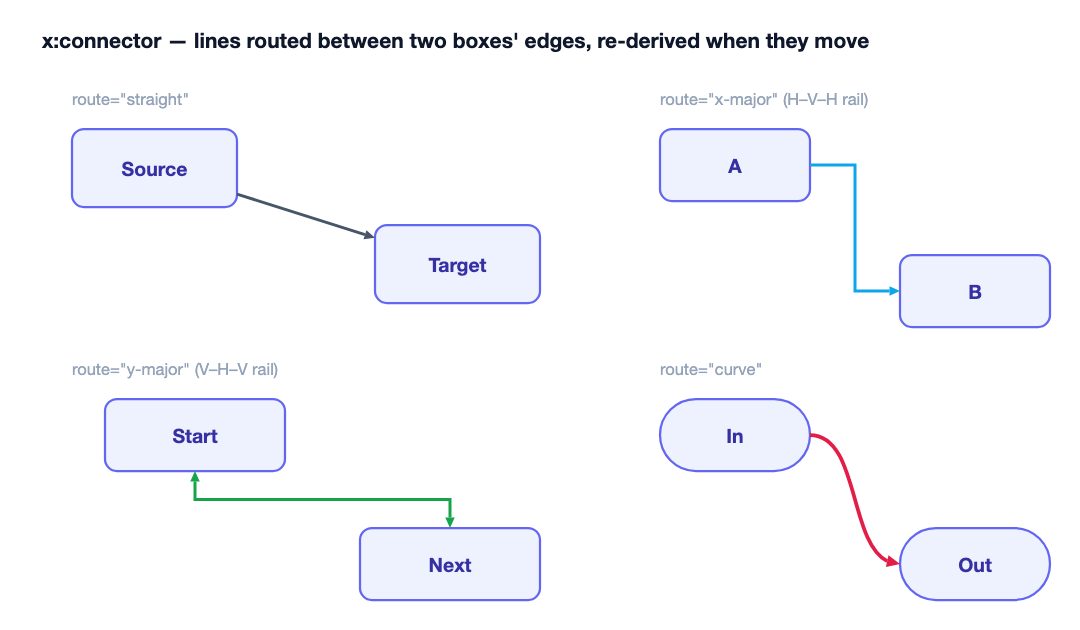
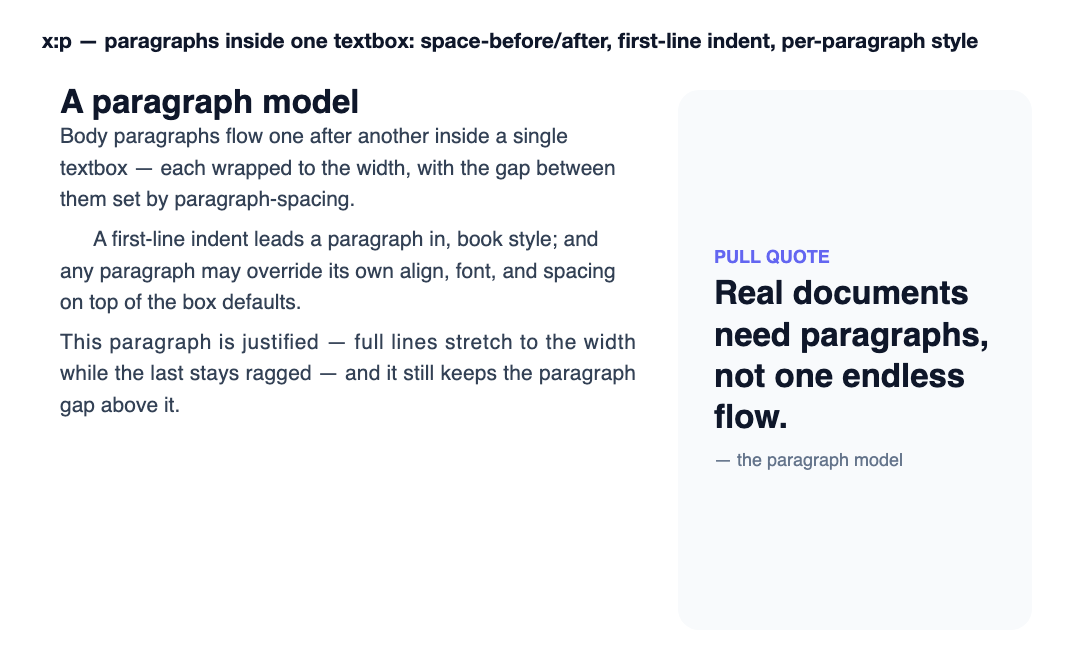
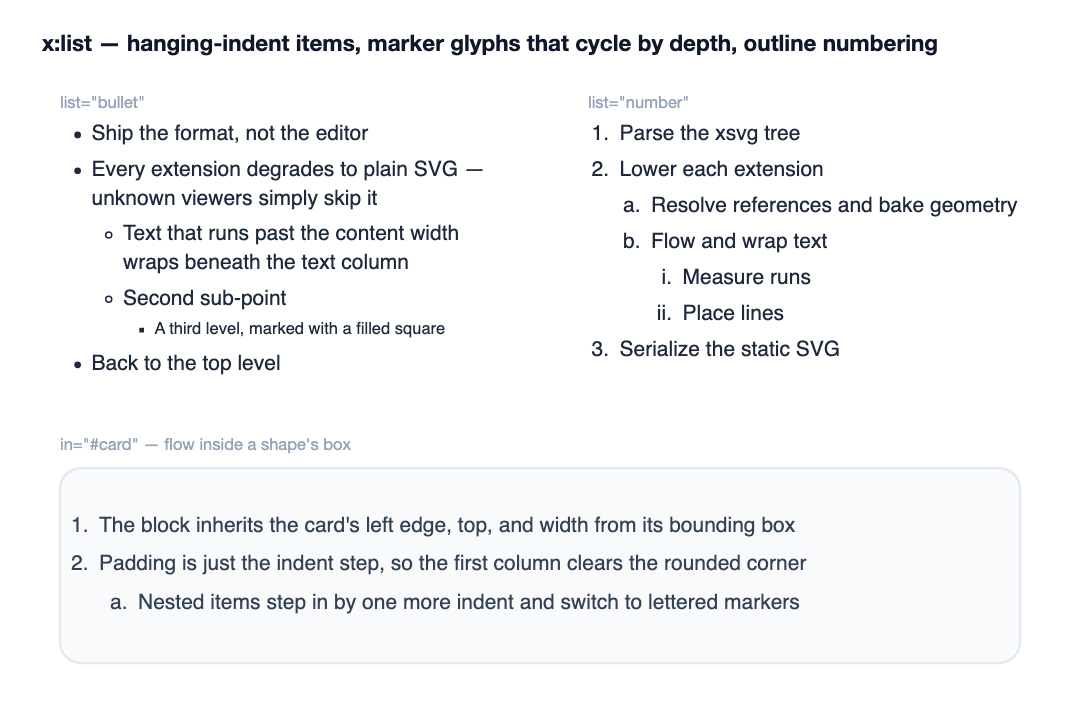
The document primitives SVG lacks. <x:p> stacks paragraphs with spacing, indents and
per-paragraph style; <x:list> gives hanging-indent bullets/numbers with markers that cycle by
depth; <x:table> has author-set columns and row heights that grow to fit wrapped content.
<x:table cols="150 * *" stripe="#f8fafc">
  <x:tr><x:th>Feature</x:th><x:th>What it does</x:th><x:th>Degrades to</x:th></x:tr>
  <x:tr><x:td>Mesh gradients</x:td><x:td>Corner colours on curved Coons patches…</x:td><x:td>PNG</x:td></x:tr>
</x:table>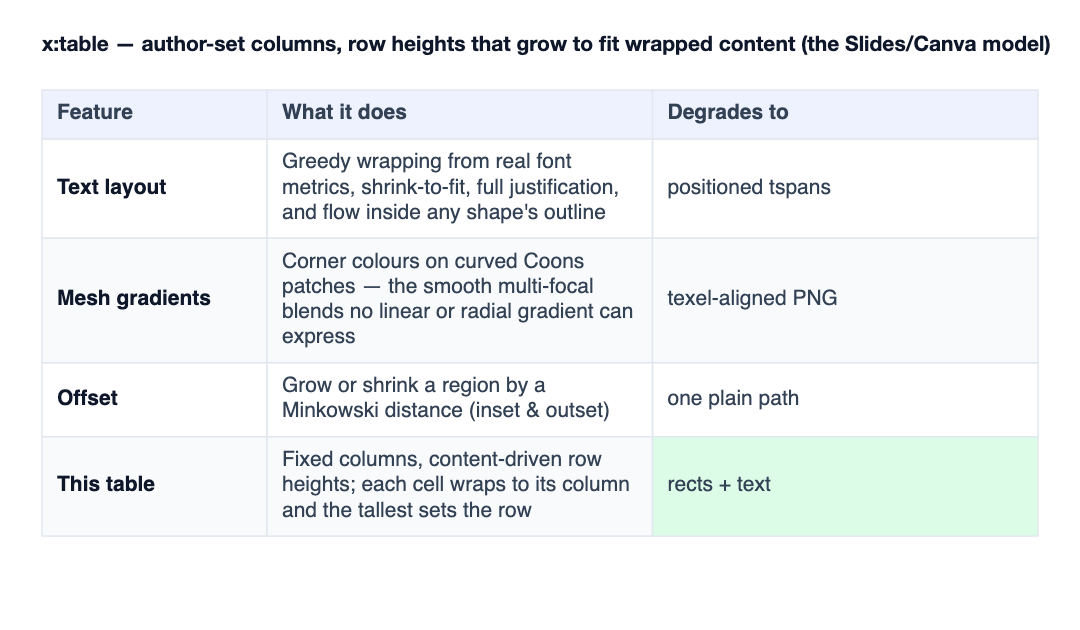
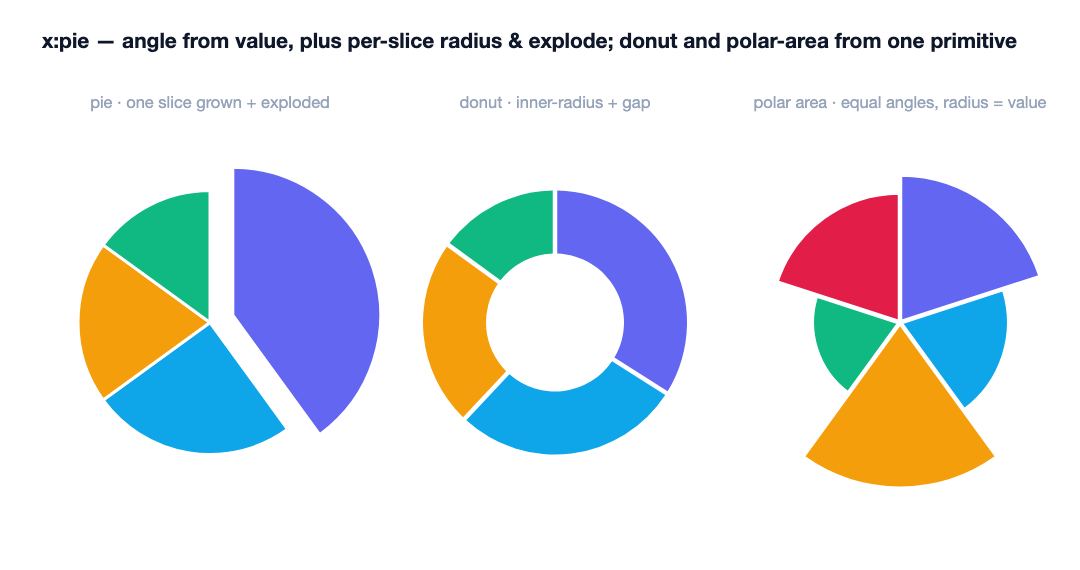
A data-coordinate frame: <x:plot> maps a domain onto a pixel box (y inverted) and draws
bottom-aligned <x:bars> and mapped <x:line> graphs; <x:pie> turns a value into an angle, with
per-slice radius, explode, donut, and polar-area — all baked to plain shapes, no chart runtime.
<x:plot y-domain="0 100" y-ticks="5">           <x:pie cx="80" cy="80" r="70" inner-radius="36">
  <x:bars fill="#6366f1">                          <x:slice value="40" fill="#6366f1"/>
    <x:bar value="45" label="Q1"/>                 <x:slice value="25" fill="#0ea5e9"/>
    <x:bar value="72" label="Q2"/>                 <x:slice value="35" fill="#f59e0b"/>
  </x:bars>                                       </x:pie>
</x:plot>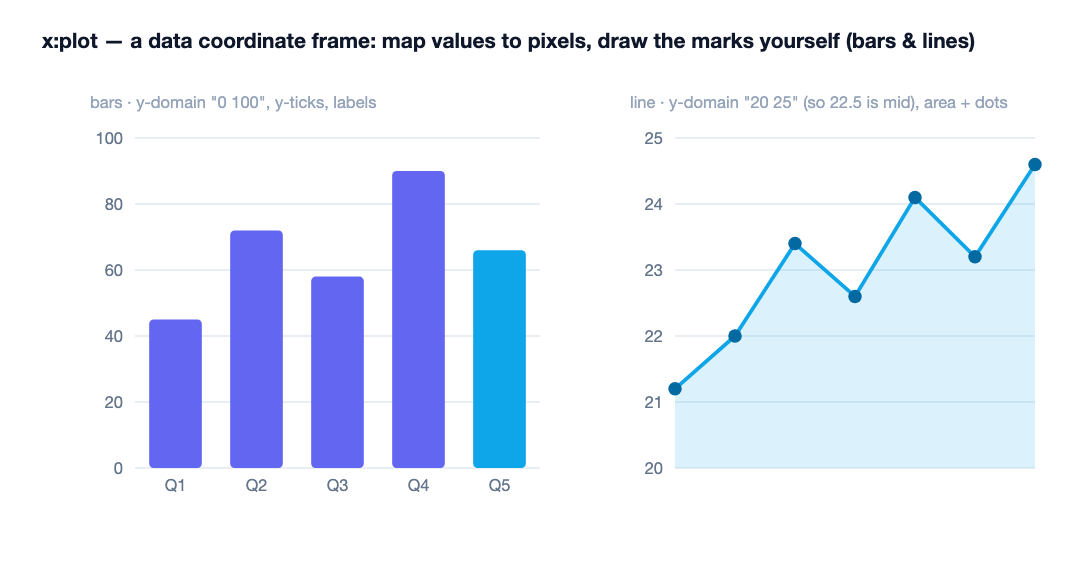
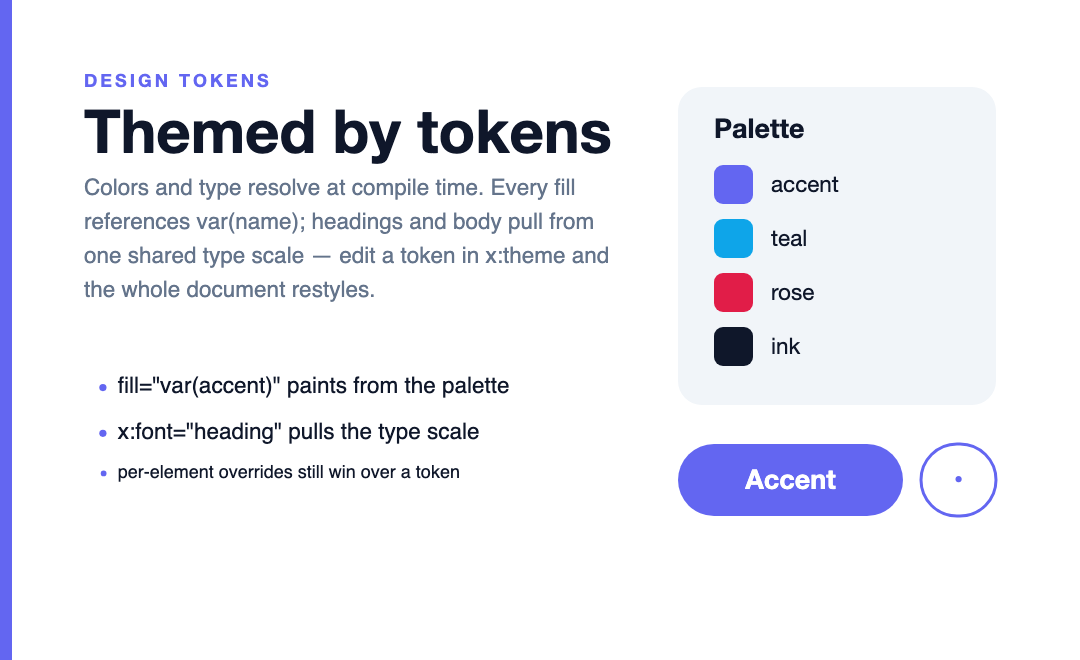
<x:theme> declares design tokens — a brand palette and a type scale — resolved at compile time.
Fills reference var(name); text pulls a named x:font. Change a token and the whole document
restyles; an unknown viewer never sees the var() (it's already resolved).
| Name | Kind | What it is |
|---|---|---|
@visioncortex/xsvg-viewer |
npm · browser | WASM compiler + createPreview slide-deck surface |
@visioncortex/xsvg-compile |
npm · Node | Browser-free compile(); opentype.js fonts, synchronous |
xsvg-cli |
crate · binary | The xsvg CLI — pure-Rust AOT compile, no browser |
xsvg-core |
crate · lib | The compiler + geometry/text/gradient primitives (compile feature) |
One Rust compiler, two platform backings. xsvg-core holds the whole lowering pipeline behind
three platform seams — font metrics, glyph outlining, and shape rasterization (for text flow).
xsvg-wasm backs them with browser callbacks (canvas, opentype.js) for the viewer; xsvg-cli and
the Node package back them with native libraries (ttf-parser, kurbo, opentype.js). Because the
browser and native paths run the same compiler, their output is verified pixel-identical for
geometry and within a hair for text — see docs/Headless.md.
nvm use          # Node (pinned via .nvmrc)
npm install
npm run dev      # build the wasm (debug) + start Vite → http://localhost:5173
The dev app is a hub linking a live playground, an interactive viewer (pan/zoom + a
source-mapped element inspector), and a bare preview. Open any sample by name, e.g.
/playground/?file=pie.xsvg.
| Command | What it does |
|---|---|
npm run dev |
wasm (debug) + Vite dev server, hot reload |
npm run build |
wasm (release) + bundle the tool pages + single-file embed |
npm run build:packages |
build both npm packages (release wasm + dist) |
npm run compare |
browser-vs-native parity suite over every sample |
cargo test |
the compiler's Rust test suite |
- Specification.md — the normative spec: language + lowering rules
- Syntax.md — language design (a graceful-degradation superset of SVG)
- Typography.md — the typesetting capabilities catalog
- Headless.md — the native compiler + browser-parity test suite
- Vision.md · Plan.md · Research.md — north star, architecture, prior art
MIT © 2026 Seafire Software Limited.