A local-first desktop and web application for browsing, searching, and analyzing AI agent coding sessions. Supports Claude Code, Codex, OpenCode, and 8 other agents.
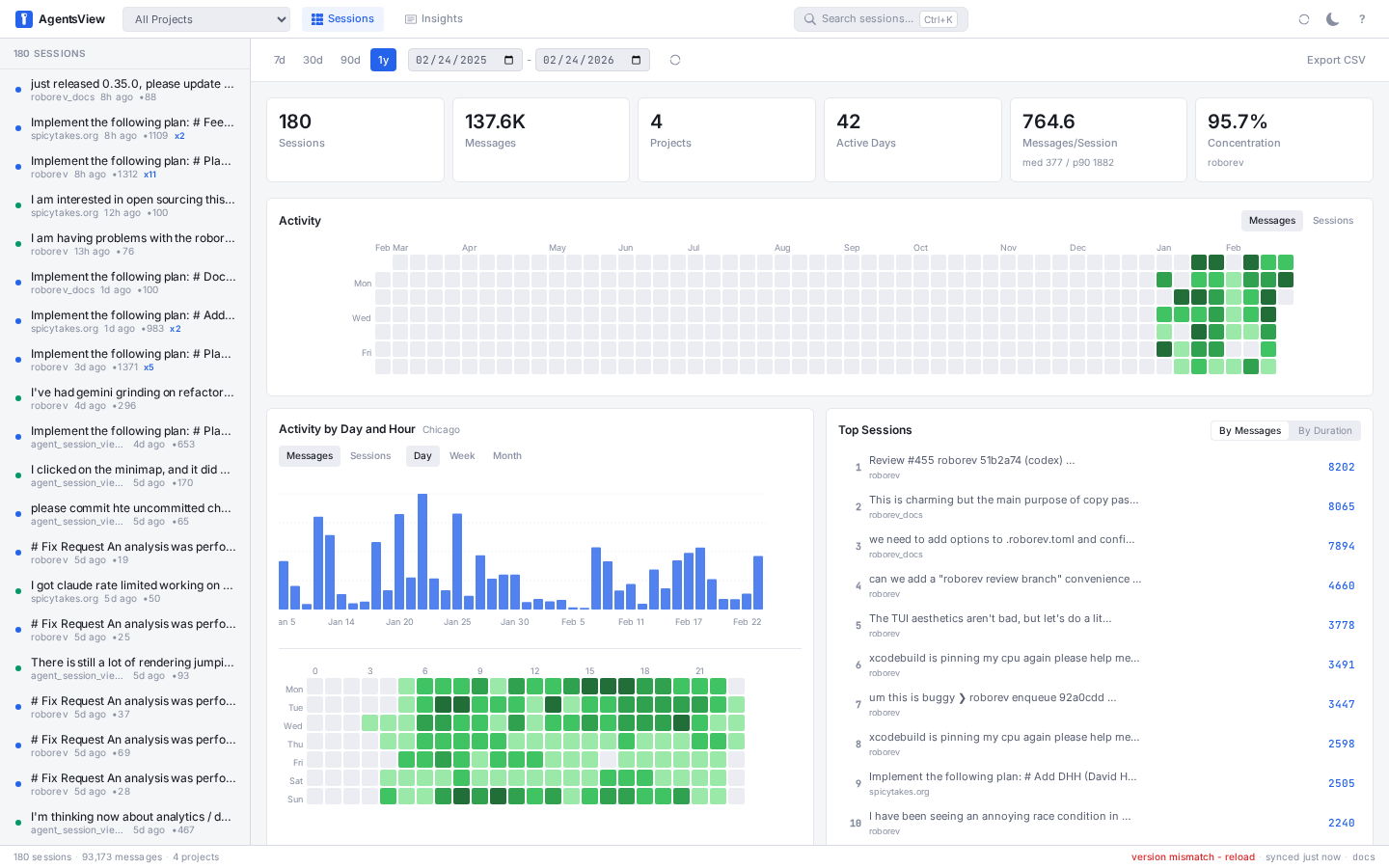
Download the desktop installer for macOS or Windows from GitHub Releases. The desktop app includes auto-updates and runs the server as a local sidecar -- no terminal required.
curl -fsSL https://agentsview.io/install.sh | bashWindows:
powershell -ExecutionPolicy ByPass -c "irm https://agentsview.io/install.ps1 | iex"The CLI installer downloads the latest release, verifies the SHA-256 checksum, and installs the binary.
Build from source (requires Go 1.25+ with CGO and Node.js 22+):
git clone https://github.com/wesm/agentsview.git
cd agentsview
make build
make install # installs to ~/.local/binAI coding agents generate large volumes of session data across projects. agentsview indexes these sessions into a local SQLite database with full-text search, providing a web interface to find past conversations, review agent behavior, and track usage patterns over time.
- Full-text search across all message content, instantly
- Analytics dashboard with activity heatmaps, tool usage, velocity metrics, and project breakdowns
- Multi-agent support for Claude Code, Codex, OpenCode, and 8 other agents (full list)
- Live updates via SSE as active sessions receive new messages
- Keyboard-first navigation (vim-style
j/k/[/]) - Export and publish sessions as HTML or to GitHub Gist
- Local-first -- all data stays on your machine, single binary, no accounts
agentsview              # start server
agentsview -port 9090   # custom port
On startup, agentsview discovers sessions from all supported
agents, syncs them into a local SQLite database with FTS5
full-text search, and opens a web UI at http://127.0.0.1:8080.
For hostname or reverse-proxy access, set a public_url. This
preserves the default DNS-rebinding and CSRF protections while
explicitly trusting the external browser origin you expect.
# Direct HTTP on a custom hostname/port
agentsview -host 0.0.0.0 -port 8004 \
  -public-url http://viewer.example.test:8004

# HTTPS behind your own reverse proxy
agentsview -host 127.0.0.1 -port 8004 \
  -public-url https://viewer.example.test
agentsview can also manage a Caddy frontend for you. In managed-Caddy
mode, keep the backend on loopback and let Caddy terminate TLS and
optionally restrict client IP ranges. By default, managed Caddy binds
to 127.0.0.1 and exposes the public URL on port 8443. To expose it
on a non-loopback interface, set -proxy-bind-host explicitly and
provide at least one -allowed-subnet.
Managed Caddy mode requires the caddy CLI to already be installed.
This patch does not automate Caddy installation. Use your normal OS
package manager or ask your coding agent to install Caddy for your
platform first. Caddy supports Linux, macOS, and Windows.
For privileged ports such as 443 or 80, prefer leaving
agentsview itself unprivileged and granting the Caddy binary
permission to bind low ports. On Linux, that typically means:
sudo setcap cap_net_bind_service=+ep "$(command -v caddy)"Then run agentsview normally as your user with -public-port 443
or -public-port 80. This avoids running the session viewer as root,
which would otherwise change which home directory and agent session
data it can see. If you do not need a privileged port, the default
8443 is the simpler option.
agentsview -host 127.0.0.1 -port 8080 \
  -public-url https://viewer.example.test \
  -proxy caddy \
  -proxy-bind-host 0.0.0.0 \
  -public-port 8443 \
  -tls-cert ~/.certs/viewer.crt \
  -tls-key ~/.certs/viewer.key \
  -allowed-subnet 10.0/16 \
  -allowed-subnet 192.168.1.0/24
You can persist the same settings in ~/.agentsview/config.toml:
public_url = "https://viewer.example.test"

[proxy]
mode = "caddy"
bind_host = "0.0.0.0"
public_port = 8443
tls_cert = "/home/user/.certs/viewer.crt"
tls_key = "/home/user/.certs/viewer.key"
allowed_subnets = ["10.0/16", "192.168.1.0/24"]
public_origins remains available as an advanced override when you
need to allow additional browser origins beyond the main public_url.
| Dashboard | Session viewer |
|---|---|
|
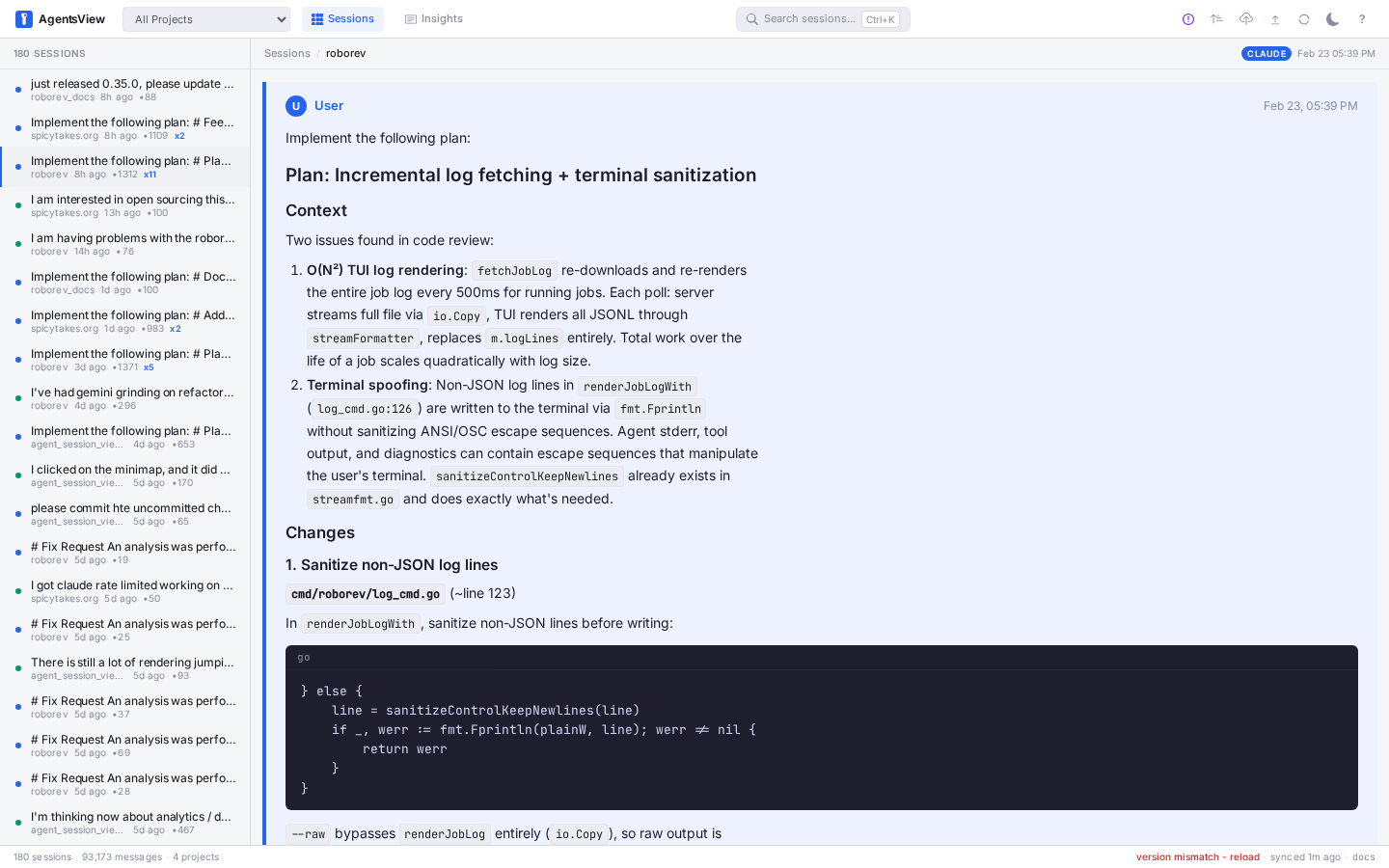 |
| Search | Activity heatmap |
|---|---|
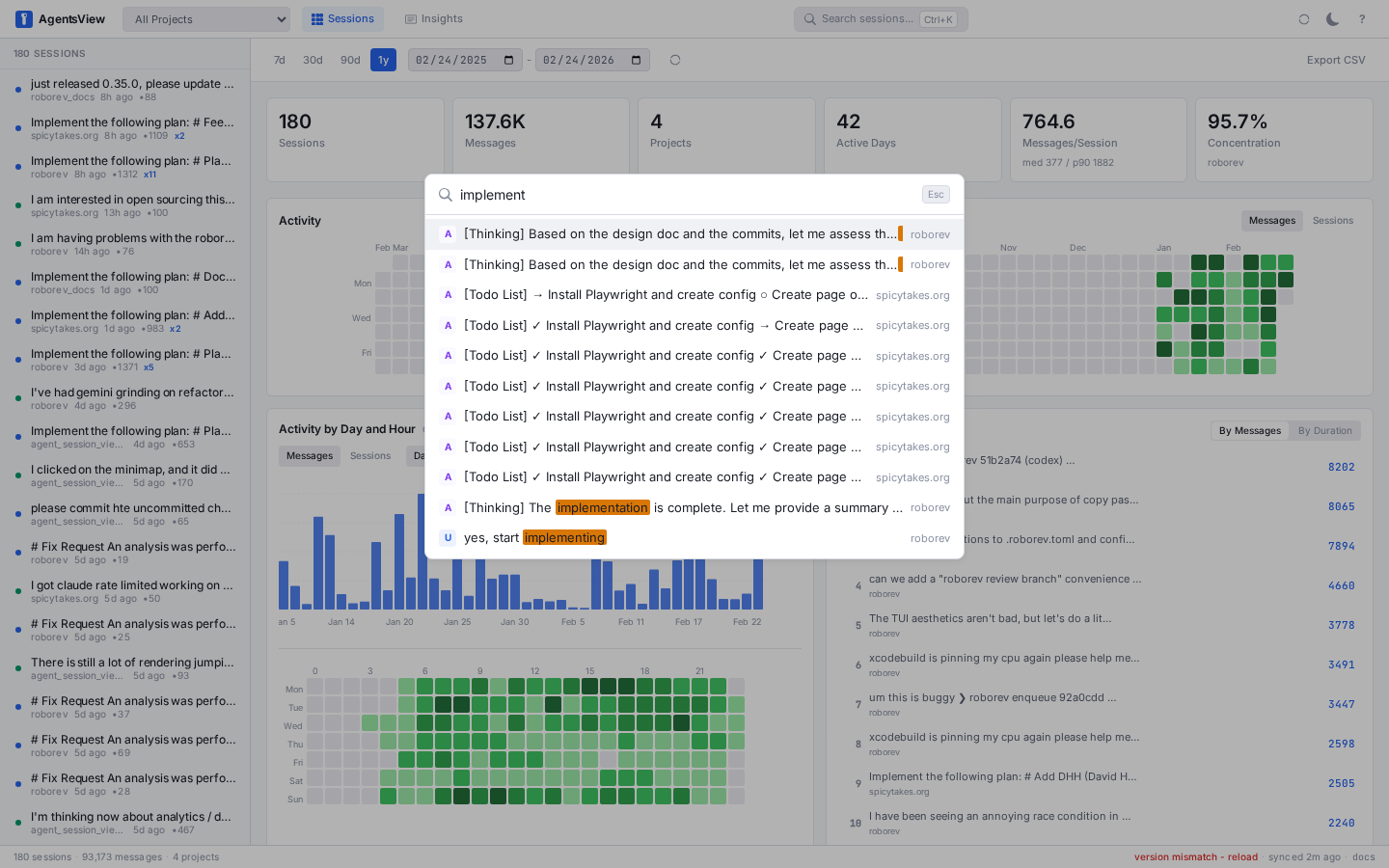 |
 |
| Key | Action |
|---|---|
Cmd+K |
Open search |
j / k |
Next / previous message |
] / [ |
Next / previous session |
o |
Toggle sort order |
t |
Toggle thinking blocks |
e |
Export session as HTML |
p |
Publish to GitHub Gist |
r |
Sync sessions |
? |
Show all shortcuts |
agentsview can push session data from the local SQLite database to a remote PostgreSQL instance, enabling shared team dashboards and centralized search across multiple machines.
Configure pg in ~/.agentsview/config.toml:
[pg]
url = "postgres://user:pass@host:5432/dbname?sslmode=require"
machine_name = "my-laptop"
Use sslmode=require (or verify-full for CA-verified connections)
for non-local PostgreSQL instances. Only use sslmode=disable for
trusted local/loopback connections.
The machine_name identifies which machine pushed each session
(must not be "local", which is reserved).
CLI commands:
agentsview pg push          # push now
agentsview pg push --full   # force full re-push (bypasses heuristic)
agentsview pg status        # show sync status
Push is on-demand — run pg push whenever you want to sync to
PostgreSQL. There is no automatic background push.
Serve the web UI directly from PostgreSQL with no local SQLite.
Configure [pg].url in config (as shown above), then:
agentsview pg serve              # default: 127.0.0.1:8080
agentsview pg serve -port 9090   # custom port
This mode is useful for shared team viewers where multiple machines
push to a central PG database and one or more read-only instances
serve the UI. Uploads, file watching, and local sync are disabled.
By default, pg serve binds to 127.0.0.1. When a non-loopback
-host is specified, remote access is enabled automatically and an
auth token is generated and printed to stdout.
- Deleted sessions: Sessions permanently pruned from SQLite
(via
agentsview prune) are not propagated as deletions to PG. Sessions soft-deleted withdeleted_atare synced correctly. - Change detection: Push uses aggregate length statistics
rather than content hashes. Use
-fullto force a complete re-push if content was rewritten in-place.
Full documentation is available at agentsview.io:
- Quick Start -- installation and first run
- Usage Guide -- dashboard, session browser, search, export
- CLI Reference -- commands, flags, and environment variables
- Configuration -- data directory, config file, session discovery
- Architecture -- how the sync engine, parsers, and server work
make dev            # run Go server in dev mode
make frontend-dev   # run Vite dev server (use alongside make dev)
make desktop-dev    # run Tauri desktop app in dev mode
make test           # Go tests (CGO_ENABLED=1 -tags fts5)
make lint           # golangci-lint
make e2e # Playwright E2E testsThe desktop app is a Tauri wrapper under desktop/. It launches
the agentsview Go binary as a local sidecar and loads
http://127.0.0.1:<port> in a native webview.
make desktop-dev                 # run desktop app in dev mode
make desktop-build               # build desktop bundles (.app/.exe)
make desktop-macos-app           # build macOS .app only
make desktop-windows-installer   # build Windows installer (.exe)
Desktop env escape hatch: ~/.agentsview/desktop.env (for
PATH/API keys overrides).
cmd/agentsview/     CLI entrypoint
internal/config/    Configuration loading
internal/db/        SQLite operations (sessions, search, analytics)
internal/postgres/  PostgreSQL support (push sync, read-only store, schema)
internal/parser/    Session parsers (all supported agents)
internal/server/    HTTP handlers, SSE, middleware
internal/sync/      Sync engine, file watcher, discovery
frontend/           Svelte 5 SPA (Vite, TypeScript)
| Agent | Session Directory | Env Override |
|---|---|---|
| Claude Code | ~/.claude/projects/ |
CLAUDE_PROJECTS_DIR |
| Codex | ~/.codex/sessions/ |
CODEX_SESSIONS_DIR |
| Copilot | ~/.copilot/ |
COPILOT_DIR |
| Gemini | ~/.gemini/ |
GEMINI_DIR |
| OpenCode | ~/.local/share/opencode/ |
OPENCODE_DIR |
| Cursor | ~/.cursor/projects/ |
CURSOR_PROJECTS_DIR |
| Amp | ~/.local/share/amp/threads/ |
AMP_DIR |
| iFlow | ~/.iflow/projects/ |
IFLOW_DIR |
| VSCode Copilot | ~/Library/Application Support/Code/User/ (macOS) |
VSCODE_COPILOT_DIR |
| Pi | ~/.pi/agent/sessions/ |
PI_DIR |
| OpenClaw | ~/.openclaw/agents/ |
OPENCLAW_DIR |
Inspired by claude-history-tool by Andy Fischer and claude-code-transcripts by Simon Willison.
MIT